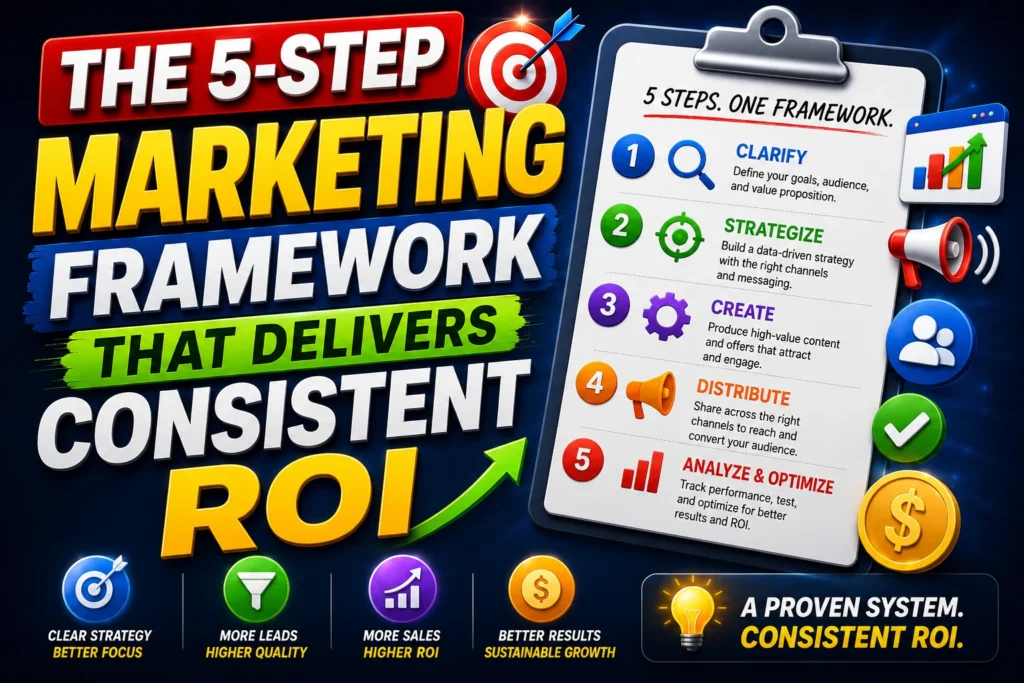
5-Step Marketing Framework for Consistent ROI 2026
Stop running campaigns without this 5-Step Marketing Framework for getting consistent ROI. I use it to launch and optimise marketing campaigns that deliver consistent ROI every single time. The most dangerous place you can be in digital marketing is busy without being profitable. The 5-Step Marketing Framework to Get A Consistent ROI I have seen it more times than I can count — businesses running Google Ads, Meta Ads, and SEO simultaneously, spending serious money every month, and getting back results that do not add up. The dashboard looks active. The campaigns are running. But when you pull back and look at actual revenue generated versus actual money spent, the numbers either barely break even or quietly bleed red. The reason is almost always the same. There is no system behind the spending. There is an ad here because someone said video ads are working. A retargeting campaign is there because a competitor seems to be doing it. A blog post because content marketing is important. Individual pieces, individually reasonable, but no consistent logic connecting them — and therefore no consistent outcome from them. The businesses that dominate their digital channels in 2026 are not those with the biggest budgets — they are the ones with the most disciplined execution systems. That is what this article is about. What I am sharing here is the five-step framework I use every time I launch or audit a marketing campaign — for ecommerce stores, real estate projects, SaaS businesses, and service providers. It is the same logic regardless of industry. It is the reason some campaigns consistently produce predictable ROI while others consistently disappoint. Why Most Marketing Campaigns Fail Before They Launch The Guesswork Problem Most marketing campaigns are built on optimism rather than structure. The offer sounds good. The creative looks clean. The budget feels reasonable. So the campaign goes live — and then the wait begins. Did it work? Maybe check in a week. Maybe adjust something. Maybe try a different audience. Sporadic optimisation — the “set and check quarterly” approach — produces consistently mediocre results. The gap between campaigns that work and campaigns that do is not explained by spend. It is explained by whether there is a systematic process behind them. What a Framework Actually Does A proper campaign framework does four things that guesswork cannot. It forces clarity before money is spent — on who the audience is, what outcome you want, and how you will measure success. It creates a repeatable process that produces comparable results across different campaigns and different channels. It separates what is working from what is not, so you scale the right things rather than scaling everything and hoping for the best. And it gives you a structured diagnostic when something goes wrong — instead of staring at a dashboard wondering what to change. A strong marketing accountability framework ensures that every campaign is tied to measurable KPIs, supported by reliable analytics systems, and aligned with business objectives. Here is the framework, step by step. Step 1: Define the Outcome Before You Define the Campaign Start With the Revenue Goal, Not the Ad Format The single most common mistake I see when reviewing campaigns is that someone decides on the channel and format before determining what outcome they actually need. “We need to run Facebook Ads” is not a marketing strategy. “We need to generate 40 qualified leads per month at a cost of under ₹500 per lead to meet this quarter’s sales target” is a strategy. Everything else follows from that clarity. Before any campaign is built, I answer four questions without compromise: What is the specific, measurable outcome this campaign needs to produce? Not “more leads” or “more traffic” — a number. 50 leads. 200 purchases. 1,000 email subscribers. A number creates accountability and makes every subsequent decision testable. What is the maximum cost per outcome that makes this campaign financially viable? If your product margin is ₹4,000 and your average customer only buys once, spending ₹2,500 to acquire them leaves a thin ₹1,500 margin. The acceptable CPL or CPA is a business mathematics question, not a marketing question. Who exactly is this campaign trying to reach? Not a demographic. A person. What do they worry about? What language do they use when searching for what you offer? What has stopped them from buying before? The more specifically you can answer this, the more precisely your creative, copy, and targeting can address it. How will you measure success? Before the campaign launches, the measurement system needs to exist—conversion tracking, UTM parameters, CRM integration. Continuous testing and optimisation are crucial to maximising your digital marketing ROI — but you cannot optimise what you cannot measure. Answer these four questions completely before touching any ad platform, and the campaign you build will be fundamentally more coherent than 80% of what your competitors are running. Step 2: Build the Funnel, Not Just the Ad Why Single-Ad Campaigns Almost Always Underperform A single ad asking a cold audience for a purchase, a booking, or a high-commitment action is structurally inefficient. People do not buy from strangers. They buy from sources they have encountered, found useful, and begun to trust. In 2026, social media is a discovery engine, lead generator, and brand-building powerhouse. The role of each touchpoint in the customer journey is different — and treating them as interchangeable is where most ad budgets leak. The Three Funnel Stages That Work Together Top of Funnel — Awareness and Discovery. This is where you introduce yourself to people who match your buyer profile but do not yet know you exist. The goal is not conversion. The goal is attention and a positive first impression. Video content, educational posts, and problem-aware messaging work here. Cost is low. Conversion intent is low. But this stage builds a warm audience that makes everything downstream cheaper. Middle of Funnel — Consideration and Trust. This is where you deepen the relationship with people who have already engaged with your
5-Step Marketing Framework for Consistent ROI 2026 Read More »