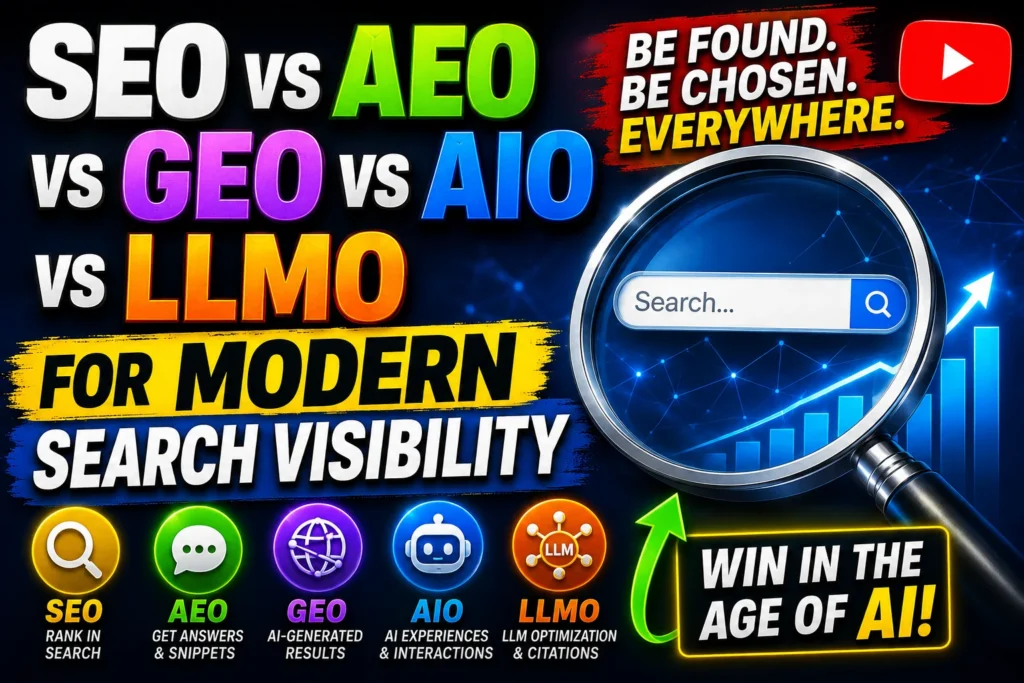
Learn everything about the SEO vs AEO vs GEO vs AIO vs LLMO — Complete Guide to Search Visibility in 2026. SEO is not dead — it is being rewritten. I break down SEO, AEO, GEO, AIO, LLMO, and every related optimisation discipline in plain language, with real tactics for each, and tell you exactly which ones matter for your business right now.
SEO vs AEO vs GEO vs AIO vs LLMO for Modern Search Visibility
Every week I see a new article declaring that SEO is dead. Every week, that article misses the point entirely.
SEO is not dead. It is being rewritten — and something more layered, more intelligent, and more interesting has taken its place. What used to be a game of keywords and backlinks has become a system for feeding machines the right information so they can read our content as we intended.
When I first started working in digital marketing, the search landscape was simple by comparison. You identified keywords, built content around them, earned some links, and tracked your position in Google. The metrics were clear. The tactics were agreed upon.
In 2026, I spend time thinking about things that did not exist as disciplines three years ago. How does a piece of content get cited inside a ChatGPT answer? How does a brand become part of what an AI model considers authoritative on a topic? What does it mean to be visible when 69% of searches now end without a click?
This article answers those questions. It explains every modern search optimisation discipline — SEO, AEO, GEO, AIO, LLMO, and the others worth knowing — in plain language, with honest tactics for each, and a clear answer to which ones actually matter for your specific situation in 2026.
Why the Search Landscape Changed So Fast
The Numbers That Explain Everything
Two statistics explain why this conversation is happening now, and why it matters more than another “SEO is evolving” think piece.
AI Overviews reduced click-through rates for top-ranking Google content by 58%. That is not a marginal shift. That is a structural change in how traffic flows from search to websites. Pages that ranked first on Google and expected a predictable stream of clicks are seeing that stream reduce because Google is answering the question before users need to click anything.
Zero-click searches hit 69% by May 2025, and AI search traffic grew 527% year-over-year between January 2024 and May 2025. People are getting answers without leaving search. And increasing numbers of users are going directly to AI tools — ChatGPT, Perplexity, Claude — for queries they would previously have Googled.
This does not mean traditional SEO is finished. It means that ranking on page one of Google is no longer the complete definition of search visibility. There are new surfaces — AI-generated summaries, voice answers, LLM responses — and each one requires a slightly different approach to be included in it.
The Terminology Problem
Before I define each discipline, I want to address the confusion directly.
The terminology is new, unstandardised, and applied inconsistently across the industry. This matters because you are not confused due to a knowledge gap — the terms themselves are genuinely unsettled.
Princeton University researchers formally defined GEO in November 2023. LLMO emerged from practitioner communities around the same time. AEO predates both but has been repurposed for AI contexts. Different agencies use these terms to mean different things. My goal here is to give you working definitions that are accurate enough to make practical decisions — not to settle a naming debate that the industry itself has not resolved.
The Full Stack of Search Optimisation in 2026
Think of modern search visibility as a layered system. Each layer builds on the one below it. You cannot skip the foundation and expect the upper layers to perform.
Layer 1 — SEO: Technical health, crawlability, keyword relevance, backlinks. The foundation everything else depends on.
Layer 2 — AEO: Structuring content to appear in direct answer placements — featured snippets, People Also Ask, voice search.
Layer 3 — GEO: Optimising content to be cited inside AI-generated summaries across search engines and AI-first platforms.
Layer 4 — LLMO: Technical optimisation specifically for how large language models retrieve, process, and cite content in conversational responses.
Layer 5 — AIO: Integrating AI tools into your marketing operations to work more efficiently across all four layers above.
SEO, AEO, GEO, and LLM optimisation are not competing methods — they are connected layers in the same system. Each one builds on the previous, forming a full stack of visibility across both human and machine discovery.
Let me explain each one in full.
SEO — Search Engine Optimisation Has Not Gone Anywhere
What SEO Is in 2026
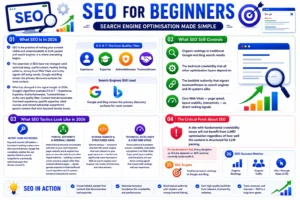
SEO is the practice of making your content visible and understandable to both people and search engines. It is where everything begins.
The essentials in SEO have not changed: solid technical setup, useful content, healthy linking patterns, strong Core Web Vitals and entity signals still bring results. Google and Bing remain the primary discovery surfaces for most content.
What has changed is the signal weight. In 2026, Google’s algorithms evaluate E-E-A-T — Experience, Expertise, Authoritativeness, Trustworthiness — as the core quality filter. Content that demonstrates first-hand experience, specific expertise, cited sources, and named authorship outperforms generic content that ticks keyword density boxes.
What SEO Still Controls
- Organic rankings in traditional Google and Bing search results
- The technical crawlability that all other optimisation layers depend on
- The backlink authority that signals trustworthiness to search engines and AI systems alike
- Core Web Vitals — page speed, layout stability, interactivity — as direct ranking signals
What SEO Tactics Look Like in 2026
Keyword research still matters — but intent matching matters more than keyword density. A page that completely satisfies the real question behind a search outperforms a technically optimised page that dances around it.
Internal linking structure concentrates authority on your most important pages and tells search engines how topics on your site relate to each other. Topical authority — building a content cluster around a subject rather than isolated individual pages — signals genuine expertise to both traditional search algorithms and the AI systems trained on indexed web content.
Schema markup — structured data that tells search engines what each element of your page represents — has become significantly more important in 2026 as search engines use it to power rich results, AI Overviews, and voice answers.
The Critical Point About SEO
A site with fundamental crawlability issues will not benefit from LLMO optimisation regardless of how well the content is structured for LLM parsing.
Fix the foundation first. Every discipline on this list depends on SEO working correctly underneath it.
SEO targets: Traditional search rankings in Google and Bing.
SEO success metric: Organic rankings, organic traffic, click-through rates.
AEO — Answer Engine Optimisation: Being Selected as the Direct Answer
What AEO Is
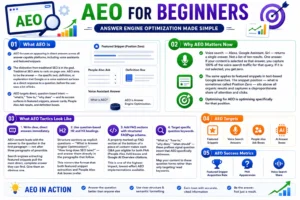
AEO focuses on appearing in direct answers across all answer-capable platforms, including voice assistants and featured snippets.
The distinction from traditional SEO is in the goal. Traditional SEO aims to rank on page one. AEO aims to be the answer — the specific text, definition, or explanation that Google or a voice assistant surfaces as a direct response to a question, before the user sees a list of links.
AEO targets direct, question-based intent — “what is,” “how to,” “why does” — and its success surfaces in featured snippets, answer cards, People Also Ask results, and definition boxes.
Why AEO Matters Now
Voice search — Alexa, Google Assistant, Siri — returns a single answer. Not a list of ten results. One answer. If your content is selected as that answer, you capture 100% of the voice search traffic for that query. If it is not selected, you get zero.
The same applies to featured snippets in text-based Google searches. The snippet position — what is sometimes called Position Zero — sits above all organic results and captures a disproportionate share of attention and clicks. Optimising for AEO is optimising specifically for that position.
What AEO Tactics Look Like
Write clear, direct answers immediately.
AEO content leads with the answer to the question in the first paragraph — not after three paragraphs of preamble. Search engines extracting featured snippets pull the most direct, complete answer they can find. Give them an obvious one.
Use question-based H2 and H3 headings.
Structure sections as explicit questions — “What is Answer Engine Optimisation?”, “How long does SEO take?” — and answer them directly in the paragraphs that follow. This mirrors the format that both featured snippet extraction and People Also Ask boxes prefer.
Add FAQ sections with structured FAQPage schema.
A properly marked-up FAQ section at the bottom of a piece of content makes each Q&A pair eligible for both PAA (People Also Ask) boxes and Google AI Overview citations. This is one of the highest-impact, lowest-effort AEO implementations available.
Target specific question keywords.
“What is,” “how to,” “why does,” “when should” — these prefixes signal question intent that AEO specifically addresses. Map your content to these question forms rather than only targeting head keywords.
AEO targets: Featured snippets, voice search answers, People Also Ask boxes, AI answer boxes. AEO success metric: Featured snippet acquisition rate, PAA appearances, voice search share.
GEO — Generative Engine Optimisation: Being Cited in AI-Generated Answers
What GEO Is
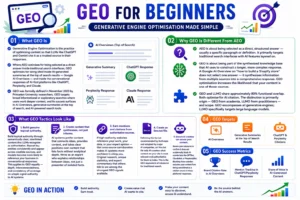
Generative Engine Optimisation is the practice of optimising content so that LLMs like ChatGPT and Gemini cite it as a trusted source in their responses.
Where AEO optimises for being selected as a direct answer inside traditional search interfaces, GEO optimises for being cited inside the AI-generated summaries that appear at the top of search results — Google AI Overviews — and inside the conversational responses of AI-first platforms like ChatGPT, Perplexity, and Claude.
GEO was formally defined in November 2023 by Princeton University researchers. GEO targets broad informational or exploratory searches where users want deeper context, and its success surfaces in AI Overviews, generative summaries at the top of search, and AI-powered search tools.
Why GEO Is Different From AEO
The distinction matters and gets confused frequently.
AEO is about being selected as a direct, structured answer — usually a specific paragraph or definition. It primarily targets traditional search interfaces with AI features layered on.
GEO is about being part of the synthesised knowledge base that AI uses to construct a longer, more complex response. A Google AI Overview on a topic like “how to build a Shopify store” does not select one answer — it synthesises information from multiple sources into a comprehensive response. GEO optimisation increases the likelihood that your content is one of those sources.
GEO and LLMO share approximately 80% functional overlap. Both optimise for AI citation. The distinction is primarily origin — GEO from academia, LLMO from practitioners — and scope. GEO encompasses all generative engines; LLMO specifically targets large language models.
What GEO Tactics Look Like
Build genuine topical authority.
LLMO builds topical authority through semantically clear, interlinked content that LLMs recognise as authoritative. Repeat key entities consistently and appear across credible sources, and models become more likely to reference your business in conversational responses. This applies to GEO equally — depth, interconnectedness, and consistency of coverage on a topic signal authority to AI systems.
Create content that synthesises, not just informs.
AI systems prefer content that connects ideas, provides context, and takes clear positions over content that lists facts without analytical depth. Write as an expert who explains relationships between ideas, not just a presenter of isolated facts.
Earn mentions and citations from authoritative sources.
If high-authority websites reference your work, your data, or your expert opinion — that cross-source corroboration makes AI systems more confident in citing you. Original research, unique statistics, and expert commentary that others link to are among the strongest GEO signals available.
Create an llms.txt file.
Following the format recommended by Anthropic and adopted by major AI companies, an llms.txt file tells AI crawlers what content on your site is most relevant and authoritative for them to index. This is the GEO equivalent of robots.txt for traditional search.
Ensure AI crawlers can access your content.
Review your robots.txt to confirm it does not accidentally block AI crawler bots like GPTBot, ClaudeBot, or PerplexityBot. Blocking these crawlers excludes your content from being considered as a citation source in those platforms’ responses.
GEO targets: AI Overviews, generative summaries at the top of search results, ChatGPT and Perplexity citations.
GEO success metric: Brand citation rate in AI Overviews, mention tracking in ChatGPT/Perplexity responses, Share of Voice in AI-generated content.
LLMO — Large Language Model Optimisation: The Technical Layer of AI Visibility
What LLMO Is
LLMO is the practice of optimising content specifically for large language models like ChatGPT, Claude, and Gemini. LLMO is essentially the technical subset of GEO, focused on how LLMs retrieve and cite content through training data and retrieval-augmented generation (RAG) pipelines. If you are doing GEO, you are already doing most of LLMO.
Where GEO thinks about which AI platforms to optimise for and what content strategy to pursue, LLMO goes deeper into the technical mechanics of how LLMs actually process, store, retrieve, and generate content from what they have indexed.
What Makes LLMO Distinct
Large language models work differently from search engines. They do not return a list of ranked links — they synthesise answers from multiple sources using a combination of what they learned during training and what they retrieve in real-time through RAG pipelines.
LLMs thrive on semantically rich, vector-friendly content, and strategic presence in high-authority sources that LLMs already reference. These models are not search engines in the traditional sense — instead of crawling the web in real time, they rely on what they have been optimised for.
Understanding this distinction matters because it changes the optimisation approach. You cannot “rank” in an LLM the same way you rank in Google. You can become part of the knowledge base that an LLM considers reliable and representative on a topic.
What LLMO Tactics Look Like
Entity clarity and consistency.
LLMs understand the world in terms of entities — people, organisations, places, concepts — and their relationships. If your brand name, your author’s name, and your topic expertise are consistently described in the same way across your website, your social profiles, your directory listings, and other websites that mention you, LLMs develop a clearer, more confident representation of who you are and what you know.
Semantic richness over keyword density.
LLMs process meaning, not keyword frequency. Content that explains the relationships between concepts, uses precise terminology, and discusses a topic in depth gives LLMs more signal to work with than content that repeats the same keyword 15 times.
Structured, chunked content.
LLMs parse content by breaking it into manageable chunks for embedding and retrieval. Clear paragraph breaks, logical section progression, and content that flows naturally from one idea to the next is easier for LLMs to process accurately than dense, unbroken text walls.
Presence on LLM-referenced sources.
Wikipedia, major industry publications, academic citations, government sources — these are the high-authority sources LLMs were trained on most heavily. Being mentioned, cited, or referenced by these sources puts your brand, your data, or your expert perspective into the knowledge base that LLMs draw from.
LLMO targets: Conversational LLM responses in ChatGPT, Claude, Gemini, and Perplexity. Training data influence and real-time RAG retrieval.
LLMO success metric: Brand citation rate in LLM responses, query tracking across major AI platforms, entity recognition in AI knowledge graphs.
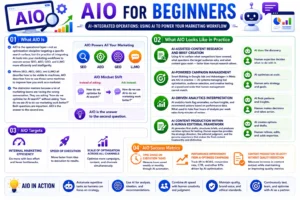
AIO — AI-Integrated Operations: Using AI to Power Your Marketing Workflow
What AIO Is
AIO is the operational layer — not an optimisation discipline targeting a specific search surface, but the practice of integrating AI tools into your marketing workflows to execute across SEO, AEO, GEO, and LLMO more efficiently and intelligently.
Where SEO, AEO, GEO, and LLMO all describe how to be visible to machines, AIO describes how to use those same machines to improve how you work as a marketer.
The distinction matters because a lot of marketing teams are having the wrong conversation. They are asking “how do we optimise for AI search?” without asking “how do we use AI to do our marketing work better?” Both questions are important. AIO is the answer to the second one.
What AIO Looks Like in Practice
AI-assisted content research and brief creation.
Using AI to surface what competitors have covered, what questions the target audience asks, and what content gaps exist — faster than manual research allows. The AI does the discovery. Human expertise decides what to do with it.
AI-powered campaign management.
Smart Bidding in Google Ads and Advantage+ in Meta are AIO in practice — AI systems managing bid optimisation, audience selection, and creative testing at a speed and scale that human management cannot match.
AI-driven analytics interpretation.
AI analytics tools flag anomalies, surface insights, and recommend actions based on performance data. What used to take four hours of analysis per week takes forty minutes of review when AI handles the pattern recognition.
AI content production within a human editorial framework.
AI generates first drafts, structures briefs, and produces variation options for testing. Human expertise provides the strategic direction, the editorial judgment, and the genuine experience that makes the final content trustworthy and distinctive.
AIO targets: Internal marketing efficiency, speed of execution, scale of optimisation across all channels.
AIO success metric: Time saved on execution tasks, performance improvement from AI-optimised campaigns, content production velocity without quality reduction.
AI SEO: The Umbrella Term
AI SEO is the umbrella term that contains AEO, GEO, and LLMO. Any agency offering GEO, AEO, or LLMO is technically offering a subset of AI SEO. The term also covers using AI tools for traditional SEO tasks — content generation, keyword research, and competitive analysis.
If you see someone offering “AI SEO” as a service, ask them which specific disciplines they cover. The term is broad enough to mean almost anything, which makes it almost meaningless as a descriptor on its own.
Voice Search Optimisation (VSO): The AEO Application for Audio Surfaces
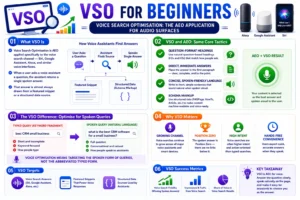
Voice Search Optimisation is AEO applied specifically to the voice search channel — Siri, Google Assistant, Alexa, and similar voice interfaces.
When a user asks a voice assistant a question, the assistant returns a single spoken answer. That answer is almost always drawn from a featured snippet or a structured data source. VSO and AEO therefore share the same core tactics: question-format headings, direct immediate answers, concise language that reads naturally when spoken aloud, and schema markup that makes content machine-readable.
The specific addition for VSO: optimise for conversational, natural language queries rather than keyword fragments. People type “best CRM small business”, but they say “what is the best CRM software for a small business?” Voice optimisation means targeting the spoken form of queries, not the abbreviated typed form.
Entity SEO: The Foundation of AI Knowledge
Entity SEO deserves its own mention because it underpins every AI-adjacent discipline on this list.
An entity, in search engine terminology, is anything that has a distinct, named identity — a person, a business, a location, a concept, a product. Search engines and LLMs both understand the world in terms of entities and their relationships rather than in terms of keywords.
Entity SEO is the practice of making your business, your brand, and your expertise clearly recognisable as specific entities with well-defined attributes. Consistent NAP data (Name, Address, Phone number) across all online mentions. A comprehensive, accurate Google Business Profile. A Wikipedia page if your brand is notable enough to justify one. Consistent authorship attribution across all published content. Clear, specific descriptions of who you are and what you know.
When LLMs encounter your brand name mentioned across multiple credible sources with consistent attributes, they build a more confident entity representation. That confidence makes them more likely to cite you accurately when users ask about topics in your area of expertise.
How All of These Work Together
The confusion most marketers experience with these disciplines comes from treating them as separate strategies to be executed independently. They are not. The best strategy for 2026 is to treat these as lenses on top of SEO, not replacements for it.
Here is the practical framework I use:
Build the SEO foundation first.
Technical health, indexability, Core Web Vitals, keyword-to-intent mapping, backlink authority. Without this, no other layer performs reliably.
Layer AEO on every important piece of content.
Question-format headings, direct immediate answers, FAQPage schema, People Also Ask targeting. This costs no extra time when built into the content creation process from the start.
Apply GEO to your highest-value content and to your brand presence.
Topical authority clusters, original research that earns citations, consistent entity representation across all online surfaces, llms.txt file implementation, AI crawler access verification.
Let LLMO emerge from GEO execution.
If you are doing GEO well — semantic richness, entity clarity, authoritative citations, consistent brand representation — you are already doing 80% of LLMO. The additional 10 to 15% involves monitoring your presence in specific LLM responses and addressing gaps where your brand is absent or misrepresented.
Use AIO to execute all of the above more efficiently.
AI tools for research, brief creation, content production, analytics interpretation, and campaign management. The efficiency gains from AIO applied across SEO, AEO, GEO, and LLMO compound over time.
One of the biggest mistakes is treating these as three separate marketing departments. This leads to fragmented content and inconsistent messaging. AI systems prefer natural, human-friendly content. If your content reads well to humans, it usually performs well across all these disciplines.
Which Disciplines Should You Prioritise?
Not every business needs equal investment in every layer. Here is my honest guidance based on different situations.
If you are a small business or solo operator
Start with SEO and AEO. Fix the technical foundation. Structure your content for direct answers. Add FAQPage schema. This gives you traditional rankings plus featured snippet and voice search eligibility at minimal additional effort. GEO and LLMO become relevant once the foundation is producing results.
If you are an ecommerce stor
SEO and AEO for product and category pages. GEO for category-level informational content that builds authority in your niche. Entity SEO for consistent brand representation across all product review platforms, marketplaces, and directories. AIO for email automation and paid ad optimisation.
If you are a content publisher or blogger
SEO plus AEO are your primary disciplines — your traffic is almost entirely search-dependent and featured snippet acquisition can be transformative. GEO and LLMO become increasingly important as AI search grows, particularly for informational queries in your niche.
If you are a B2B service business
SEO for long-tail informational queries. AEO for definition and explanation queries your prospects ask. GEO and LLMO for brand awareness among the AI platforms your decision-makers are using for research. Entity SEO for establishing the expertise of your key people in your industry’s knowledge graph.
FAQs
Is SEO dead in 2026?
No. SEO is the foundation of every modern search optimisation discipline. A site with fundamental crawlability issues will not benefit from GEO or LLMO optimisation regardless of content quality. SEO is not disappearing — it is mutating. What used to be a game of keywords and backlinks is becoming a system for feeding machines the right information so they can read content the way we intended. Fix the SEO foundation before investing in any AI-specific layer above it.
What is the difference between GEO and AEO?
AEO differs more meaningfully from GEO than most comparisons acknowledge. While GEO and LLMO optimise for conversational AI responses, AEO primarily targets traditional search interfaces — featured snippets, voice results, and answer boxes. AEO content tends toward concise Q&A pairs; GEO content tends toward comprehensive depth. AEO is about being selected as a specific direct answer. GEO is about being cited in a longer AI-synthesised response.
What is LLMO and do I need it?
LLMO is the technical subset of GEO focused on how LLMs retrieve and cite content through training data and retrieval-augmented generation pipelines. If you are doing GEO well, you are already doing most of LLMO. You do not need to treat LLMO as a separate programme. Execute GEO thoroughly and LLMO outcomes follow from the same work.
How do I know if my content is appearing in AI Overviews?
Semrush’s AI Visibility Toolkit tracks brand presence in Google AI Overviews at $99/month and is currently the most accessible mainstream tool for this purpose. Manual checking — searching your target queries in Google and identifying whether your content is cited in the AI Overview — is free but time-consuming. Ahrefs and SE Ranking are also developing AI citation monitoring features in their 2026 roadmaps.
Does having more backlinks help with GEO and LLMO?
Yes, indirectly. Backlinks from authoritative sources signal trustworthiness to both traditional search algorithms and to the AI systems trained on indexed web content. Being cited by high-authority sources that LLMs reference heavily — major industry publications, academic sources, news outlets — puts your content into the knowledge base that AI systems draw from. This is one of the clearest overlaps between traditional SEO and GEO/LLMO tactics.
How do I optimise for voice search specifically?
Voice search optimisation is AEO applied to audio surfaces. Optimise for conversational, natural language query forms rather than typed keyword fragments. Lead with direct answers. Use clear, simple language that reads naturally when spoken. Implement FAQPage schema. Target question-format headings. Voice assistants pull their spoken answers from the same featured snippet and structured data sources that text-based AEO targets.
What is an llms.txt file and should I create one?
An llms.txt file is a text file placed at your domain root that tells AI crawlers which content on your site is most relevant and authoritative for their indexing. It follows the format recommended by Anthropic and adopted by major AI companies as the AI equivalent of robots.txt. For most websites, creating an llms.txt file is a low-effort, high-potential GEO implementation worth prioritising.
Conclusion: One Strategy, Multiple Lenses
The naming proliferation in modern search optimisation is confusing, and some of it is genuine marketing noise — agencies rebranding traditional SEO services under new acronyms to justify higher retainers.
But the underlying reality is not noise. Search is genuinely changing. The surfaces where people find information have multiplied. Ranking on page one of Google is not the complete definition of search visibility in 2026 — and the businesses that understand this and build strategies that address the full visibility stack will compound advantages over competitors who are still optimising for a single surface.
Instead of chasing every new acronym, focus on building content ecosystems that explain topics clearly, deeply, and consistently. When you do that, these disciplines become an outcome of good strategy, not an extra task.
The framework is clear. Build the SEO foundation properly. Layer AEO on every important piece of content as standard practice. Apply GEO to your highest-value content and brand presence. Let LLMO emerge from thorough GEO execution. Use AIO tools to work more efficiently across all four layers.
Each layer builds on the one below it. Each layer expands what visibility means. Together, they form the complete picture of how to be found, cited, and trusted in a search landscape that is increasingly driven by machines — and increasingly shaped by the quality of what human experts create.
Write for people first. Structure for machines second. The rest follows.
About the Author
Navdeep Kr — I am a digital marketer who creates content about SEO, Meta Ads, Google Ads, Website Development, and e-commerce growth strategies. I create genuine, experience-based solutions for store owners, marketers, and entrepreneurs to improve business results. If you believe that your online business is not progressing as expected. Don’t hesitate to get in touch with me to access all your online solutions in one place.