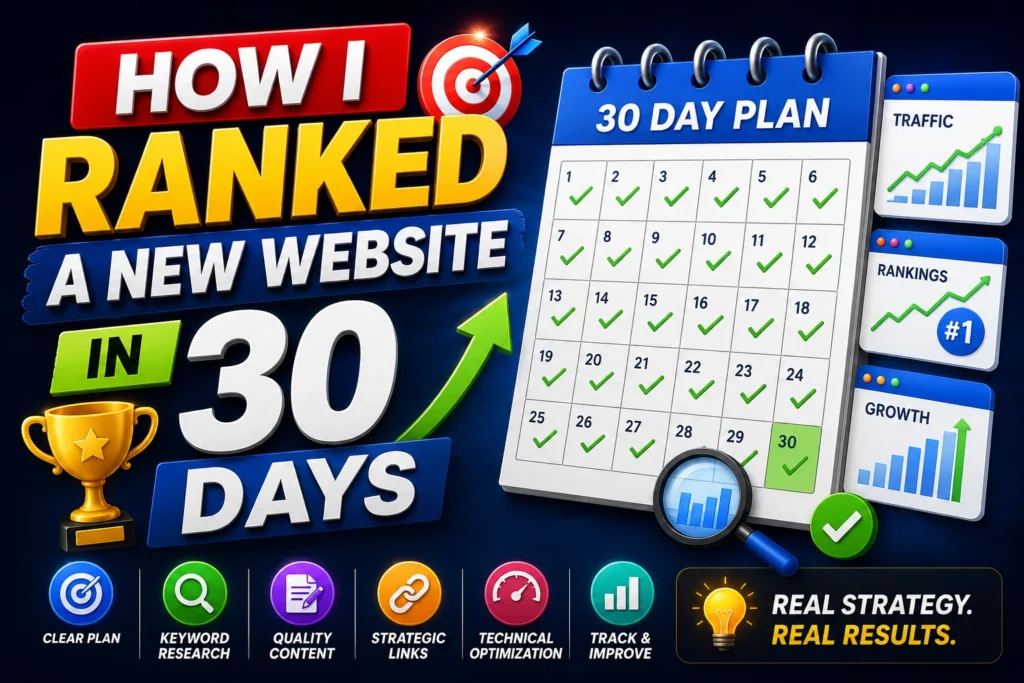
How I Ranked a New Website in 30 Days
How I Ranked a New Website in 30 Days — A Real SEO Case Study. I ranked a brand new website on Google’s first page in 30 days without paid ads. Here is the exact SEO strategy, keyword plan, content structure, and technical steps I used — with real numbers. How I Ranked a New Website in 30 Days The most common question I get from people who have just launched a website is some version of this: “I have been live for two months, and Google has not sent me a single visitor. What am I doing wrong?” Almost always, the answer is not one big thing. It is a collection of small decisions — made at setup, never revisited — that together make the site invisible to search engines. The technical foundation was skipped. The keywords were not researched properly. The content was written for the owner, not for the person searching. And no one told Google the site existed. I want to share a real case study — an actual website I built and ranked within 30 days — with the exact steps I followed, the exact mistakes I almost made, and the real numbers behind the results. Not a hypothetical framework. A specific situation with specific decisions and specific outcomes. If you are sitting with a new website that is not ranking, or you are about to launch one and want to give it the best possible start, this is the article I wish I had found when I started. What the Website Was and What I Was Working With The Project The website was a services-based site in the digital marketing niche — specifically targeting small business owners seeking help with SEO and paid advertising in Indian markets. Fresh domain. Zero domain authority. Zero backlinks. Zero existing content. The complete starting point. The competitive landscape was not empty. There were established agencies, individual consultants, and informational blogs already ranking for the terms I wanted. But there was a clear gap — none of them were speaking directly to small business owners in plain, practical language. Most of the existing content was either too technical or too generic. That gap was the opportunity. What Most People Get Wrong at This Stage Launching a new website is like opening a store in a hidden alley — you might have great products, but nobody will find you. New websites face a specific structural challenge. They lack domain authority, have no backlink profile, and compete against established players who have dominated search results for years. Google’s algorithms inherently trust older, proven websites over newcomers. The response to this challenge that does not work is trying to rank for broad, highly competitive keywords immediately. A new website cannot beat an established domain for “digital marketing agency India” in 30 days. Possibly not in 30 months. But a new website absolutely can rank for specific, lower-competition, high-intent keywords within 30 days — if the strategy is built around them from day one. That decision — targeting the right keywords before writing a single word of content — is where this entire case study begins. Week 1: Technical Foundation and Keyword Strategy Day 1 to 3 — Setting Up the Technical Foundation Before any content was written, I spent the first three days building the technical foundation that Google needs to find, crawl, and understand a new website properly. Skipping this step is the single most common reason new websites take six months to rank instead of six weeks. Google Search Console and Google Analytics 4: Connected both on day one. Submitted the XML sitemap to Search Console immediately. This tells Google the website exists and gives it a map of every page. A new website that does not submit its sitemap can wait weeks or months for Google to discover it organically. Page speed and Core Web Vitals: Ran the site through Google PageSpeed Insights on day one. Compressed all images to WebP format. Deferred non-critical JavaScript. Removed any unused plugins or scripts. Target was above 80 on mobile — achieved 87. Site architecture: Set up a clean, logical URL structure with a flat hierarchy. Homepage — Service pages — Blog. No deep nested pages. No confusing URL strings. Every important page within two clicks of the homepage. Schema markup: Added Organization schema to the homepage, Service schema to each service page, and Article schema to the blog setup before any posts were written. This tells Google precisely what each page is about and increases the likelihood of rich results from the first indexed page. robots.txt and canonical tags: Configured robots.txt to allow crawling of all content pages. Added self-referencing canonical tags to prevent any future duplicate content issues as the site grew. This took three days of focused work. None of it is glamorous. All of it is essential. Day 3 to 7 — Keyword Research Mapped to Specific Pages This is the step that determined whether the next 27 days of work would produce results or not. I made one foundational decision upfront: I would not target the keywords I wanted to rank for. I would target the keywords I could actually rank for on a new domain within 30 days — and build toward the competitive terms as authority grew. The keyword research process I followed had three stages. Stage 1 — Identify buyer-intent long-tail keywords with low competition. Using Ahrefs and Google’s own autocomplete, I built a list of keywords with search volumes between 100 and 1,000 monthly searches, keyword difficulty below 20, and clear commercial or transactional intent. Keywords like “Google Ads for small business India,” “how to improve Shopify store SEO,” and “Facebook ads for local business India” — specific enough that competition was low, intent-rich enough that ranking for them would drive actual enquiries. Stage 2 — Map each keyword to a specific page. Every keyword got assigned to one page — either an existing service page or a planned blog post. No
How I Ranked a New Website in 30 Days Read More »