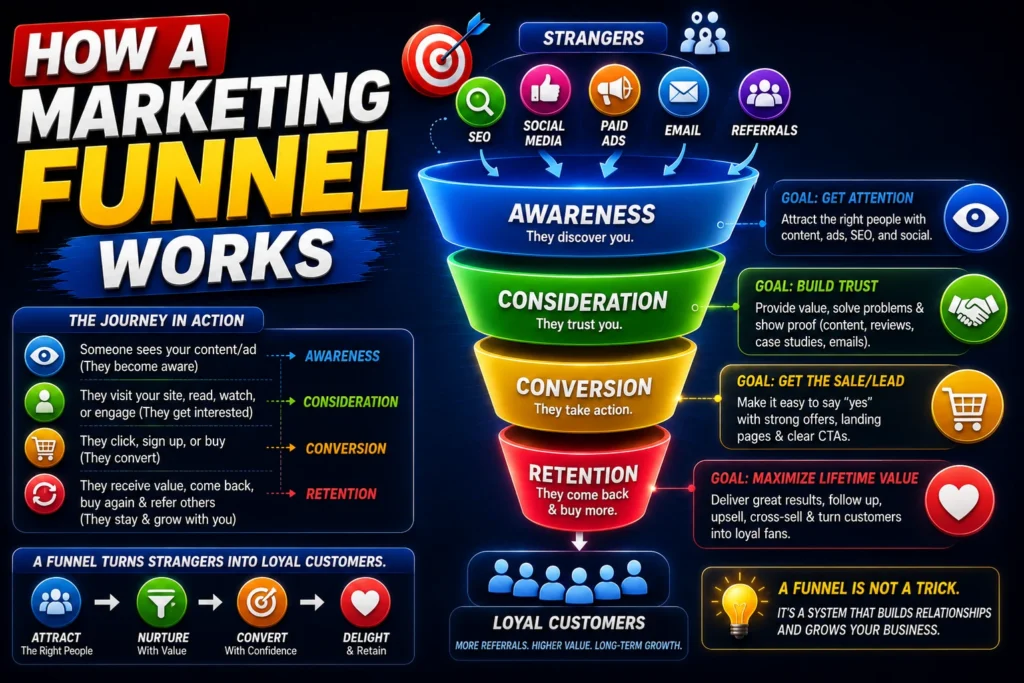
Learn how a marketing funnel works with SEO + ads in 2026. Build a step-by-step funnel that turns traffic into leads and sales using tracking, CRO, and retargeting.
A lot of people learn SEO, run Google Ads, or start Meta Ads—and still don’t get results. Not because the channels don’t work, but because they’re missing one thing:
A marketing funnel.
A funnel is what connects:
- traffic (SEO + ads)
- to leads
- to sales
- and then to repeat customers
From real campaign work I’ve seen across lead-gen and e-commerce, the biggest growth comes when you stop thinking “How do I get more clicks?” and start thinking:
✅ “How do I move people from cold → interested → ready to buy?”
This article explains the complete marketing funnel for SEO + ads, with a step-by-step system you can use to turn traffic into measurable revenue.
What is a Marketing Funnel?
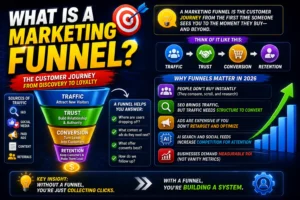
A marketing funnel is the customer journey from the first time someone sees you to the moment they buy—and beyond.
Think of it like this:
Traffic → Trust → Conversion → Retention
A funnel helps you answer:
- Where are users dropping off?
- What content or ads do they need next?
- What offer converts best?
- How do we follow up?
Why Funnels Matter in 2026
In 2026, funnels matter more because:
- People don’t buy instantly (they compare, scroll, and research)
- SEO brings traffic, but traffic needs structure to convert
- Ads are expensive if you don’t retarget and optimize
- AI search and social feeds increase competition for attention
- Businesses demand measurable ROI (not vanity metrics)
Key insight:
Without a funnel, you’re just collecting clicks. With a funnel, you’re building a system.
Marketing Funnel Stages
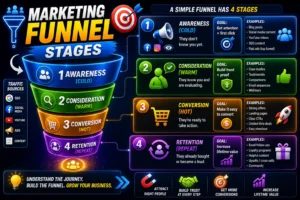
A simple funnel has 4 stages:
1) Awareness (Cold)
They don’t know you yet.
Goal: Get attention + first click
2) Consideration (Warm)
They know you and are evaluating.
Goal: Build trust + proof
3) Conversion (Hot)
They’re ready to take action.
Goal: Make it easy to convert
4) Retention (Repeat)
They already bought or became a lead.
Goal: Increase lifetime value
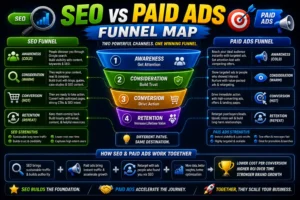
SEO vs Paid Ads Funnel Map Step-by-Step System
Step 1: Start With One Clear Goal (What is Your “Conversion”?)
Funnels fail when the goal isn’t defined.
Pick one primary conversion:
- Lead form submission
- Phone call
- WhatsApp click
- Purchase
- Book a consultation
Beginner rule:
One funnel = one main conversion goal.
Step 2: Build Your Offer (The Funnel Needs a Reason to Convert)
Traffic doesn’t convert just because your website exists.
You need a clear offer, such as:
- Free consultation
- Price estimate
- Limited-time discount
- Free checklist/guide (lead magnet)
- Trial/demo
- Bundle offer
Offer checklist:
✅ Clear benefit
✅ Low friction
✅ Strong reason to act
✅ Matches intent
Step 3: Awareness Stage
This stage is all about bringing the right people into your world.
A) SEO for Awareness (Top-of-Funnel Content)
Content types that work:
- “How to” guides
- beginner tutorials
- problem-solving blogs
- definitions + comparisons
Examples:
- “SEO for beginners”
- “Best digital marketing tools”
- “How to reduce CPL in Meta ads.”
Goal: Get targeted traffic and build authority.
B) Cold Ads for Awareness
Meta Ads works great here:
- Reels/video ads
- carousel education
- interest targeting
Google Ads can also work for awareness using:
- broad problem keywords (carefully)
- display/video remarketing later
Best practice:
At the awareness stage, sell curiosity—not the final sale.
Step 4: Consideration Stage (Trust Builders That Convert)
Once someone clicks, your funnel should help them trust you.
Best Consideration Assets
- case studies with results
- comparison pages
- testimonials/reviews
- detailed service pages
- “How it works” pages
- email nurture sequence (optional)
Content examples:
- “SEO case study: page 1 rankings in 6 months.”
- “Google Ads vs Meta Ads: which is better?”
- “What results are expected from SEO in 90 days?”
Ads for Consideration (Warm Targeting)
Target:
- website visitors (7–30 days)
- video viewers
- Instagram/Facebook engagers
Objective:
- traffic → to case studies or proof pages
- leads → for free consultation
Key insight:
Trust is built through proof, not promises.
Step 5: Conversion Stage (Landing Page + CTA + CRO)
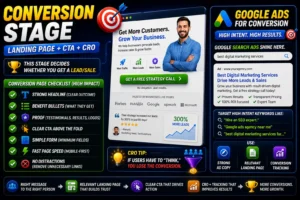
This stage decides whether you get a lead/sale.
Conversion Page Checklist (High Impact)
✅ Strong headline (clear outcome)
✅ Benefit bullets (what they get)
✅ Proof (testimonials, results, logos)
✅ Clear CTA above the fold
✅ Simple form (minimum fields)
✅ Fast page speed (mobile-first)
✅ No distractions (remove unnecessary links)
CRO tip:
If users have to “think,” you lose the conversion.
Google Ads for Conversion (High Intent)
Google Search Ads shine here.
Target keywords like:
- “Hire an SEO expert.”
- “Google ads agency near me”
- “best digital marketing services for…”
Use:
- strong ad copy
- relevant landing page
- conversion tracking
Step 6: Retargeting in Funnels (Where Profit Happens)
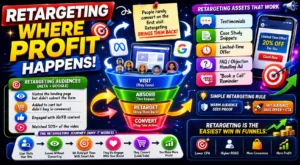
Retargeting is the easiest win in funnels.
People rarely convert on the first visit. Retargeting brings them back.
Retargeting Audiences (Meta + Google)
- visited the landing page but didn’t submit the form
- added to cart but didn’t buy (e-commerce)
- engaged with IG/FB content
- watched 50%+ of the video
Retargeting Assets That Work
- testimonials
- case study snippets
- limited-time offer
- FAQ/objection handling ad
- “Book a call” reminder
Simple retargeting rule:
- Warm audience sees proof
- Hot audience sees offer + CTA
Step 7: Tracking & Measurement (Funnels Need Data)
If tracking is wrong, you can’t optimize.
Must-Have Tracking Setup
- GA4 (traffic + behavior)
- Google Tag Manager (events)
- Google Ads conversion tracking
- Meta Pixel + conversion API (if possible)
Key Funnel Metrics
Awareness:
- CTR
- CPC
- bounce rate
- time on page
Consideration:
- pages per session
- scroll depth
- return visitors
- video watch %
Conversion:
- conversion rate
- CPL/CPA
- ROAS
- form completion rate
Retention:
- repeat purchases
- email open/click rate
- customer lifetime value
Two Practical Funnel Examples (You Can Copy)
Funnel Example 1: Lead Generation Funnel (SEO + Ads)
Goal: Book consultation / generate leads
- SEO blog: “SEO for beginners.”
- CTA inside blog: “Download SEO checklist” (lead magnet)
- Email follow-up: case studies + offer
- Retargeting ads: testimonials + “book a call”
- Landing page: consultation booking form
Result: Traffic becomes leads and leads become clients.
Funnel Example 2: E-commerce Funnel (SEO + Retargeting)
Goal: Product purchase
- SEO blog: “Best [product] for [problem]”
- Internal link to category/product page
- Meta ads retarget:
- view content → add to cart → purchase
- Offer:
- discount, free shipping, bundle
- CRO improvements:
- trust badges, reviews, faster checkout
Result: SEO builds demand, ads bring back buyers, and CRO boosts conversion rate.
Weekly Workflow Funnel Optimization
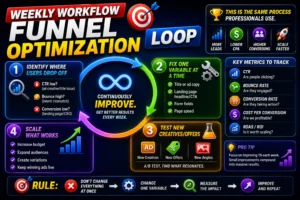
This is the same process professionals use:
- Identify where users drop off:
- CTR low? (ad creative/title issue)
- bounce high? (intent mismatch)
- conversion low? (landing page/CRO)
- Fix one variable at a time:
- title or ad copy
- landing page headline/CTA
- form fields
- page speed
- Test new creatives/offers
- Scale what works
Rule: Don’t change everything at once. Change → measure → improve.
Common Funnel Mistakes (That Waste SEO + Ad Budgets)
- Driving traffic to the homepage (no focused conversion path)
- No clear offer/CTA
- Running ads without tracking conversions
- No retargeting campaigns
- Slow landing pages (mobile)
- Too many form fields
- No trust elements (proof, reviews, results)
- Mixing goals in one campaign
Conclusion
A marketing funnel is what turns marketing from “posting and praying” into a predictable growth system.
If you want to turn SEO and ads into leads and sales, build this sequence:
Awareness (SEO + cold ads) → Consideration (proof content + warm ads) → Conversion (landing page + CRO) → Retention (follow-up + remarketing)
Once your funnel is built, results become measurable—and scalable.
(Internal link suggestion: Link to your Content Marketing Strategy article as the “next step” and to Google Ads / Meta Ads guides for execution.)
FAQs
What is a marketing funnel in digital marketing?
A marketing funnel is the step-by-step customer journey from awareness to conversion and retention, designed to turn traffic into leads and sales.
How does SEO fit into a funnel?
SEO works mainly at the awareness and consideration stages by attracting users searching for solutions and building trust with helpful content.
How do ads fit into a funnel?
Ads can drive fast traffic at awareness, capture high-intent buyers at conversion (Google Ads), and bring people back through retargeting (Meta/Google).
What is the most important part of a funnel?
Tracking + conversion stage. Without correct tracking and a high-converting landing page, even great traffic won’t produce results.
Do beginners need a funnel?
Yes. Even a simple funnel (one landing page + retargeting + clear CTA) can massively improve results compared to random traffic.
Author – Navdeep Kr –
I am a digital marketer who creates content about SEO, Meta Ads, Google Ads, Website Development, and e-commerce growth strategies. I create genuine, experience-based solutions for store owners, marketers, and entrepreneurs to improve business results. If you believe that your online business is not progressing as expected. Don’t hesitate to get in touch with me to access all your online solutions in one place.