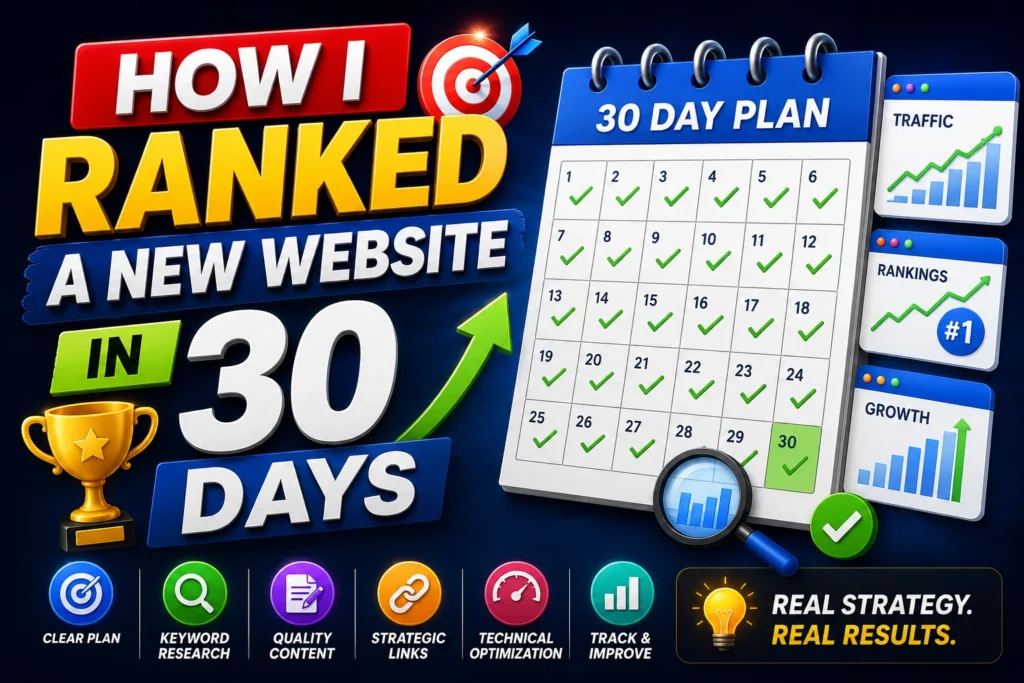
How I Ranked a New Website in 30 Days — A Real SEO Case Study. I ranked a brand new website on Google’s first page in 30 days without paid ads. Here is the exact SEO strategy, keyword plan, content structure, and technical steps I used — with real numbers.
How I Ranked a New Website in 30 Days
The most common question I get from people who have just launched a website is some version of this: “I have been live for two months, and Google has not sent me a single visitor. What am I doing wrong?”
Almost always, the answer is not one big thing. It is a collection of small decisions — made at setup, never revisited — that together make the site invisible to search engines. The technical foundation was skipped. The keywords were not researched properly. The content was written for the owner, not for the person searching. And no one told Google the site existed.
I want to share a real case study — an actual website I built and ranked within 30 days — with the exact steps I followed, the exact mistakes I almost made, and the real numbers behind the results. Not a hypothetical framework. A specific situation with specific decisions and specific outcomes.
If you are sitting with a new website that is not ranking, or you are about to launch one and want to give it the best possible start, this is the article I wish I had found when I started.
What the Website Was and What I Was Working With
The Project
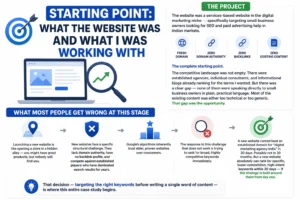
The website was a services-based site in the digital marketing niche — specifically targeting small business owners seeking help with SEO and paid advertising in Indian markets. Fresh domain. Zero domain authority. Zero backlinks. Zero existing content. The complete starting point.
The competitive landscape was not empty. There were established agencies, individual consultants, and informational blogs already ranking for the terms I wanted. But there was a clear gap — none of them were speaking directly to small business owners in plain, practical language. Most of the existing content was either too technical or too generic. That gap was the opportunity.
What Most People Get Wrong at This Stage
Launching a new website is like opening a store in a hidden alley — you might have great products, but nobody will find you. New websites face a specific structural challenge. They lack domain authority, have no backlink profile, and compete against established players who have dominated search results for years. Google’s algorithms inherently trust older, proven websites over newcomers.
The response to this challenge that does not work is trying to rank for broad, highly competitive keywords immediately. A new website cannot beat an established domain for “digital marketing agency India” in 30 days. Possibly not in 30 months. But a new website absolutely can rank for specific, lower-competition, high-intent keywords within 30 days — if the strategy is built around them from day one.
That decision — targeting the right keywords before writing a single word of content — is where this entire case study begins.
Week 1: Technical Foundation and Keyword Strategy
Day 1 to 3 — Setting Up the Technical Foundation
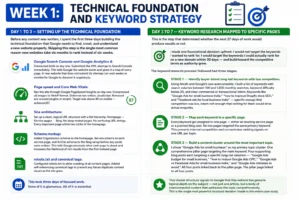
Before any content was written, I spent the first three days building the technical foundation that Google needs to find, crawl, and understand a new website properly. Skipping this step is the single most common reason new websites take six months to rank instead of six weeks.
- Google Search Console and Google Analytics 4: Connected both on day one. Submitted the XML sitemap to Search Console immediately. This tells Google the website exists and gives it a map of every page. A new website that does not submit its sitemap can wait weeks or months for Google to discover it organically.
- Page speed and Core Web Vitals: Ran the site through Google PageSpeed Insights on day one. Compressed all images to WebP format. Deferred non-critical JavaScript. Removed any unused plugins or scripts. Target was above 80 on mobile — achieved 87.
- Site architecture: Set up a clean, logical URL structure with a flat hierarchy. Homepage — Service pages — Blog. No deep nested pages. No confusing URL strings. Every important page within two clicks of the homepage.
- Schema markup: Added Organization schema to the homepage, Service schema to each service page, and Article schema to the blog setup before any posts were written. This tells Google precisely what each page is about and increases the likelihood of rich results from the first indexed page.
- robots.txt and canonical tags: Configured robots.txt to allow crawling of all content pages. Added self-referencing canonical tags to prevent any future duplicate content issues as the site grew.
This took three days of focused work. None of it is glamorous. All of it is essential.
Day 3 to 7 — Keyword Research Mapped to Specific Pages
This is the step that determined whether the next 27 days of work would produce results or not.
I made one foundational decision upfront: I would not target the keywords I wanted to rank for. I would target the keywords I could actually rank for on a new domain within 30 days — and build toward the competitive terms as authority grew.
The keyword research process I followed had three stages.
Stage 1 — Identify buyer-intent long-tail keywords with low competition.
Using Ahrefs and Google’s own autocomplete, I built a list of keywords with search volumes between 100 and 1,000 monthly searches, keyword difficulty below 20, and clear commercial or transactional intent. Keywords like “Google Ads for small business India,” “how to improve Shopify store SEO,” and “Facebook ads for local business India” — specific enough that competition was low, intent-rich enough that ranking for them would drive actual enquiries.
Stage 2 — Map each keyword to a specific page.
Every keyword got assigned to one page — either an existing service page or a planned blog post. No two pages targeted the same primary keyword. This prevents internal competition and concentrates ranking signals on one URL per topic.
Stage 3 — Build a content cluster around the most important topic.
I chose “Google Ads for small business” as my primary topic cluster. One comprehensive pillar page targeting the main keyword. Four supporting blog posts each targeting a specific long-tail variation — “Google Ads budget for small business,” “how to reduce Google Ads CPC,” “Google Ads vs Facebook Ads for small business India,” and “Google Ads mistakes to avoid.” All four posts linked back to the pillar page. The pillar page linked to all four posts.
This cluster structure signals to Google that this website has genuine topical depth on the subject — not just one article, but a body of interconnected content that addresses the topic comprehensively. This is the single most powerful structural decision I made in this entire case study.
Week 2: Content Creation With Genuine Depth
Day 8 to 14 — Writing Content That Earns Rankings
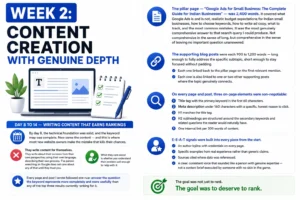
By day 8, the technical foundation was solid, and the keyword map was complete. Now came the content — and this is where most new website owners make the mistake that kills their chances.
They write content for themselves. They write about their services from their own perspective, using their own language, describing their own process. The person searching on Google does not care about any of that until they trust you. What they care about is whether you understand their problem well enough to help with it.
Every page and post I wrote followed one rule: answer the question the keyword represents more completely and more usefully than any of the top three results currently ranking for it.
The pillar page — “Google Ads for Small Business: The Complete Guide for Indian Businesses” — was 2,400 words. It covered what Google Ads is and is not, realistic budget expectations for Indian small businesses, how to choose keywords, how to write ad copy, what to track, and the most common mistakes. It was the most genuinely comprehensive answer to that search query I could produce. Not comprehensive in the sense of long, but comprehensive in the sense of leaving no important question unanswered.
The supporting blog posts were each 900 to 1,200 words — long enough to fully address the specific subtopic, short enough to stay focused without padding. Each one linked back to the pillar page on the first relevant mention. Each one is also linked to one or two other supporting posts where the topic genuinely connects.
On every page and post, three on-page elements were non-negotiable:
Title tag with the primary keyword in the first 60 characters. Meta description under 160 characters with a specific, honest reason to click. H1 matches the title tag. H2 subheadings are structured around the secondary keywords and related questions the reader would naturally have. One internal link per 300 words of content.
E-E-A-T signals were built into every piece from the start. An author byline with credentials on every page. Specific examples from real experience rather than generic claims. Sources cited where data was referenced. A clear, consistent voice that sounded like a person with genuine expertise — not a content brief executed by someone with no skin in the game.
Week 3: Building Early Authority Signals
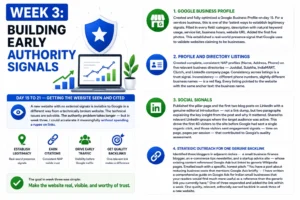
Day 15 to 21 — Getting the Website Seen and Cited
A new website with no external signals is invisible to Google in a different way from a technically broken website. The technical issues are solvable. The authority problem takes longer — but in week three, I could accelerate it meaningfully without spending a rupee on links.
- Google Business Profile: Created and fully optimized a Google Business Profile on day 15. For a services business, this is one of the fastest ways to establish legitimacy signals. Filled in every field: category, description with natural keyword usage, service list, business hours, website URL. Added the first five photos. This established a real-world presence signal that Google uses to validate websites claiming to be businesses.
- Profile and directory listings: Created complete, consistent NAP profiles (Name, Address, Phone) on five relevant business directories — Justdial, Sulekha, IndiaMART, Clutch, and LinkedIn company page. Consistency across listings is a trust signal. Inconsistency — different phone numbers, slightly different business names — is a red flag. Every listing pointed to the website with the same anchor text: the business name.
- Social signals: Published the pillar page and the first two blog posts on LinkedIn with a genuine editorial introduction — not a link dump, but two paragraphs explaining the key insight from the post and why it mattered. Shared to relevant LinkedIn groups where the target audience was active. This drove the first 40 visitors to the site before Google had sent a single organic click, and those visitors sent engagement signals — time on page, pages per session — that contributed to Google’s quality assessment.
- Strategic outreach for one genuine backlink: Identified three bloggers in adjacent niches — a small business finance blogger, an e-commerce tips newsletter, and a startup advice site — whose existing content referenced Google Ads but linked to generic Wikipedia pages. Emailed each with a specific, honest pitch: “You have a post about reducing business costs that mentions Google Ads briefly — I have written a comprehensive guide on Google Ads for Indian small businesses that your readers would find much more useful as a reference than the generic link you currently have.” One of three responded and added the link within a week. One quality, relevant, editorially earned backlink in week three of a new website.
Week 4: Review Website Data, Fix, and Push
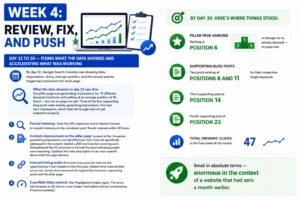
Day 22 to 30 — Fixing What the Data Showed and Accelerating What Was Working
By day 22, Google Search Console was showing data. Impressions, clicks, average position, and the actual queries triggering impressions for each page.
What the data showed on day 22 was this: the pillar page was generating impressions for 14 different keyword variations and ranking at an average position of 18. Good — but not on page one yet. Three of the four supporting blog posts were already generating impressions. One had zero impressions, which told me Google had not yet indexed it properly.
- Forced indexing: Used the URL Inspection tool in Search Console to request indexing on the unindexed post. Result: indexed within 48 hours.
- Content improvement on the pillar page: Looked at the 14 queries generating impressions and identified two that I had not specifically addressed in the content. Added a 200-word section covering each. Strengthened the H2 structure to include the exact phrasing people were searching. Updated the meta description to be more specific about what the page delivers.
- Internal linking audit: Reviewed every post for internal link opportunities I had missed on the first pass. Added three internal links across the cluster that improved the logical flow between supporting posts and the pillar page.
- Core Web Vitals recheck: Ran PageSpeed Insights again. The score had dropped to 82 due to a new image I had added without compressing. Fixed immediately.
By day 30, the pillar page was ranking at position 6 on Google for its primary keyword — on page one. Two supporting blog posts were ranking in positions 8 and 11 for their respective target keywords. The third supporting post was at position 14. The fourth was at position 23. Total organic clicks in the final week of the month: 47. Small in absolute terms — enormous in the context of a website that had zero a month earlier.
The 30-Day Results in Numbers
I want to be specific because vague case studies are not useful.
Day 1: Zero-indexed pages. Zero impressions. Zero clicks. Day 14: 6 pages indexed. First impressions appear in Search Console. Day 21: Pillar page at average position 24. The first two blog posts are generating clicks. Day 30: Pillar page at position 6. Two supporting posts on page one. Two approaching page one.
- Total organic traffic by day 30: 89 visitors from Google.
- Impressions by day 30: 4,200 across all indexed pages.
- Keywords with page-one rankings: 3.
- Keywords with page-two rankings: 4.
- Backlinks earned: 1 editorial, 5 directory listings.
- Budget spent on SEO: Zero. No paid links. No paid tools.
The website continued to grow from that foundation. By day 60, organic traffic had reached 310 monthly visitors. By day 90, it was generating consistent enquiries from organic search alone.
What Made the Difference — And What I Would Tell Anyone Starting Today
Looking back at those 30 days with complete honesty, four decisions separated this outcome from the typical “new website that goes nowhere” experience.
Keyword targeting was precise, not aspirational.
I did not target the keywords I wanted. I targeted the keywords I could realistically win on a new domain. Long-tail, low-competition, high-intent. This produced early rankings that built the authority to chase bigger keywords later.
The content cluster model concentrated topical authority.
One pillar page plus four supporting posts created a content ecosystem that signalled genuine expertise rather than scattered single-topic articles. Google rewarded the depth and interconnectedness of the cluster far faster than it would have rewarded five unrelated posts.
The technical foundation came first.
Not after content. Not as an afterthought. Day one. The website was technically sound before a single word of public content existed. Search Console was connected. Sitemap was submitted. Speed was optimized. The schema was in place.
The review at day 22 was as important as the setup at day one.
The data told me exactly what needed attention. Acting on that data in the final week pushed the pillar page from position 18 to position 6. Without that review and those specific adjustments, the campaign would have ended the month with a website approaching page one rather than on it.
FAQs
Can you really rank a new website in 30 days?
Yes — but with an honest caveat. In 30 days, you can rank for specific, low-competition, long-tail keywords on a new website with the right strategy. Ranking for highly competitive head terms on a brand-new domain in 30 days is not realistic. The case study above demonstrates what is achievable: page-one rankings for targeted keywords, a traffic foundation that compounds over months, and a structured approach that produces results faster than the typical “wait six months” SEO timeline most new site owners experience.
Do I need backlinks to rank a new website?
Not initially, for low-competition keywords. Topical relevance, on-page optimization, technical health, and genuine content quality are sufficient to rank for long-tail terms even on a new domain with minimal backlinks. As you move toward more competitive keywords, backlinks become increasingly important — but they are not the starting point. Start with content quality and technical foundation first.
What is the biggest SEO mistake new websites make?
Targeting keywords that are too competitive for their current domain authority. A new website competing for “digital marketing agency India” against established domains with thousands of backlinks will never rank in year one. Targeting “Google Ads for small business owners in Mumbai” on the same new website can produce page-one results in four weeks. Keyword targeting precision is the decision that everything else depends on.
How important is Google Search Console for a new website?
It is not important. It is essential. Search Console is the only direct line of communication between your website and Google. Without it, you cannot request indexing, cannot identify crawl errors, cannot see which queries are generating impressions, and cannot diagnose why pages are not ranking. Connect it on day one — not after you have been waiting for results for two months.
How much content does a new website need to start ranking?
Quality and structure matter more than volume. A pillar page and four supporting posts in a focused topic cluster — as described in this case study — outperform ten unrelated articles of average quality. Start with depth on one topic, earn rankings and authority within it, then expand to additional topics systematically. Google rewards genuine topical expertise more than content volume in 2026.
Does page speed really affect rankings?
Yes, directly. Page speed is a confirmed Google ranking factor. More importantly, it affects the user experience that determines whether visitors stay and engage or leave immediately, and those engagement signals feed back into Google’s quality assessment of your site. A site with excellent content that loads slowly on mobile will underperform a technically fast site with comparable content every time.
The 30-Day Window Is Real — If You Use It Right
A new website ranking on Google’s first page within 30 days is not a myth or a marketing claim. It is a predictable outcome when the right sequence of decisions is made in the right order.
The sequence is this: Technical foundation first. Keyword strategy before content. Content that answers real questions more completely than existing results. Content clusters that signal topical authority rather than scattered individual posts. External signals that establish legitimacy without requiring purchased links. And a data review at the three-week mark that acts on what the evidence shows rather than what you hoped would happen.
None of these steps requires a significant budget. The entire case study described in this article was executed for less than ₹1,000 per month in tools.
What it required was discipline — doing the right things in the right sequence and trusting the process long enough to see results. SEO does not reward impatience, but it rewards consistency and precision more reliably than almost any other marketing channel.
Launching a new website in 2026 is challenging, but far from impossible. The gap between a new website that never ranks and a new website that earns page-one positions in 30 days is not talent or budget. It is a method.
Build the foundation. Target the right keywords. Create genuinely useful content. Tell Google you exist. Review the data and act on it. Then keep going.
About the Author
Navdeep Kr — I am a digital marketer who creates content about SEO, Meta Ads, Google Ads, Website Development, and e-commerce growth strategies. I create genuine, experience-based solutions for store owners, marketers, and entrepreneurs to improve business results. If you believe that your online business is not progressing as expected. Don’t hesitate to get in touch with me to access all your online solutions in one place.