Shopify vs WooCommerce: Which is better(2026)?
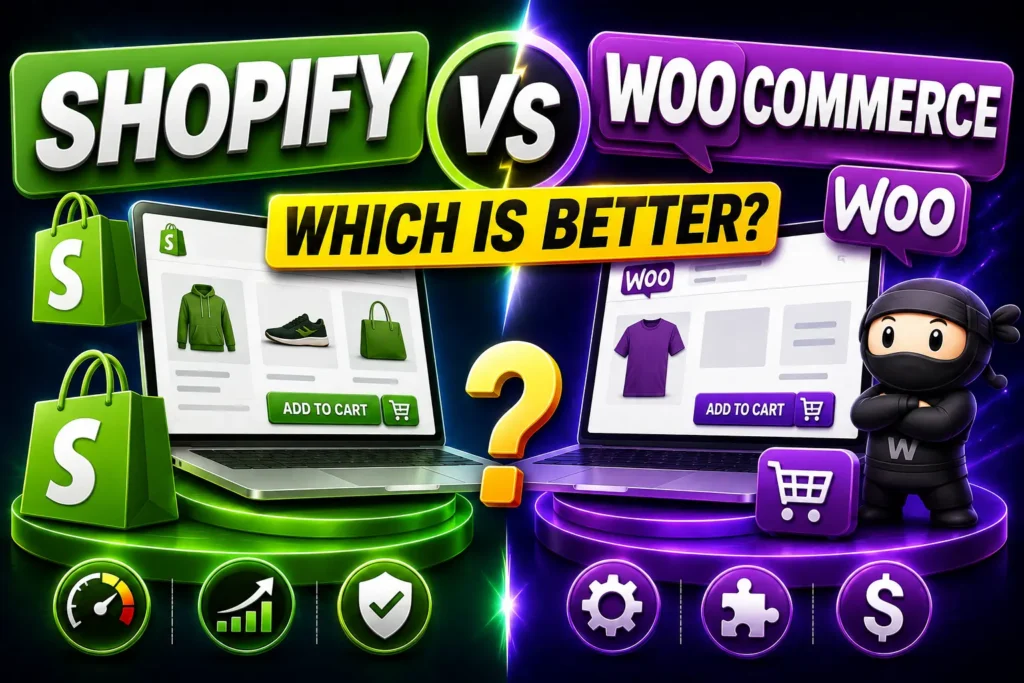
Shopify vs WooCommerce: Which is better? The question is asked more than any other when someone is starting an e-commerce business. Shopify vs WooCommerce: Which Platform Wins in 2026? Both platforms are genuinely good. Both power millions of successful online stores. And both have real limitations that nobody mentions in the sponsored comparison articles designed to send you through an affiliate link. I have worked with stores built on both platforms — simple product catalogues and complex multi-variant inventories, early-stage brands and businesses doing seven figures a year. The honest answer is that there is no universal winner. There is a winner for your specific situation, your technical comfort, your budget, and how you plan to grow. This article is that honest comparison — based on what both platforms actually look like in 2026, including the new features, the updated pricing, and the limitations that only become visible after you have been running a store for twelve months. What Each Platform Actually Is Before comparing anything, it is worth being precise about what you are actually choosing between — because they are fundamentally different types of tools. Shopify is a fully hosted, closed ecommerce platform. You subscribe to it. Shopify manages the hosting, security, performance, and software updates. You build within their system. A new store can go from signup to live in two to four hours. The trade-off is that you operate within Shopify’s boundaries — you cannot change the URL structure without workarounds, cannot fully customise the checkout without Shopify Plus, and are dependent on Shopify’s roadmap for features and pricing changes. WooCommerce is a free, open-source e-commerce plugin that runs on top of WordPress. It is not a standalone platform — it requires WordPress, a hosting plan, a domain, and configuration before your store exists. This means more setup complexity upfront, but complete ownership and control over every aspect of your store indefinitely. That fundamental difference — hosted SaaS versus self-hosted open-source — flows through every single comparison point below. Pricing: What You Actually Pay in 2026 This is where most comparison articles mislead people by quoting headline prices rather than the total cost of ownership. Shopify Pricing in 2026 Shopify’s current plans, billed annually: Basic: $29/month (~₹2,400/month) — suitable for single-person stores with basic needs Shopify: $79/month (~₹6,600/month) — for growing stores needing more staff accounts and reports Advanced: $299/month (~₹25,000/month) — for scaling businesses needing advanced analytics and lower transaction fees Shopify Plus: From $2,500/month — enterprise tier Note: Monthly billing is 25% higher across all plans. Transaction fees of 0.5% to 2% apply if you use a payment processor other than Shopify Payments. Premium apps — which most stores eventually need — add $50 to $500 per month, depending on your stack. A realistic Shopify store doing $500K in annual revenue pays approximately $4,800 to $9,600 per year when you include the plan cost, essential apps, and transaction fees. WooCommerce Pricing in 2026 The WooCommerce core plugin is free. Your real costs are: Hosting: $10 to $120 per month, depending on provider and traffic Domain: $12 to $20 per year Premium extensions: $500 to $2,000 per year for a feature-complete mid-market store Security and maintenance: either your time or a developer’s A WooCommerce store doing the same $500K in annual revenue pays approximately $2,400 to $5,400 per year. It is cheaper at most revenue levels — but it is not free in practice, and the hidden cost is the time and technical expertise required to manage it. The Honest Cost Verdict If you have zero technical background and want to focus entirely on your products and marketing, Shopify’s all-in pricing is fair for the convenience it provides. If you have technical resources — a developer on retainer, or the ability to manage WordPress yourself — WooCommerce delivers significantly better value at scale. Ease of Use: The Setup Reality Shopify wins on simplicity without any debate. A new store can go live in hours with no server management, no hosting configuration, and no plugin setup. Shopify handles everything in the background — updates, security certificates, infrastructure — while you focus on products. WooCommerce requires WordPress first. Then, the hosting setup. Then plugin configuration. Then, ongoing maintenance, updates, backups, and security monitoring. The initial setup adds 10 to 40 hours of work compared to Shopify, and that ongoing management responsibility never fully disappears. This is not a knock against WooCommerce — it is simply the nature of a self-hosted platform. The developers and store owners who prefer WooCommerce do so precisely because they want that control. But for a first-time store owner with no technical background, the setup process is genuinely complex, and the ongoing maintenance is a real ongoing commitment. If you want to launch fast with minimal technical involvement, Shopify wins clearly. If you have technical capability and want full ownership of your platform, WooCommerce is worth the setup investment. Features: What Each Platform Does Out of the Box Shopify’s built-in feature set expanded dramatically over the past year. In 2026, every plan includes: Unlimited products Discount codes and gift cards Abandoned cart recovery Basic analytics and reports Shopify POS for in-person selling — the only ecommerce platform that includes a functional point-of-sale system at standard pricing Built-in tax calculation, including automatic international tax pricing by country Shopify Payments — no additional transaction fees when used WooCommerce’s core plugin covers the essentials well but relies on extensions for most advanced functionality. Subscription products, advanced analytics, product bundles, multi-currency, memberships — these all require paid plugins. The extension library is enormous and genuinely covers almost any use case, but the cost and integration complexity add up. Shopify wins on features out of the box. WooCommerce wins on the ceiling of what is possible when you are willing to build it. AI Tools: Shopify’s Biggest 2026 Advantage This is where Shopify has pulled significantly ahead, and it deserves specific attention. Shopify Sidekick became generally available in January 2026 as part of the Winter ’26 Renaissance
Shopify vs WooCommerce: Which is better(2026)? Read More »