Shopify vs WooCommerce: Which is better? The question is asked more than any other when someone is starting an e-commerce business.
Shopify vs WooCommerce: Which Platform Wins in 2026?
Both platforms are genuinely good. Both power millions of successful online stores. And both have real limitations that nobody mentions in the sponsored comparison articles designed to send you through an affiliate link.
I have worked with stores built on both platforms — simple product catalogues and complex multi-variant inventories, early-stage brands and businesses doing seven figures a year. The honest answer is that there is no universal winner. There is a winner for your specific situation, your technical comfort, your budget, and how you plan to grow.
This article is that honest comparison — based on what both platforms actually look like in 2026, including the new features, the updated pricing, and the limitations that only become visible after you have been running a store for twelve months.
What Each Platform Actually Is
Before comparing anything, it is worth being precise about what you are actually choosing between — because they are fundamentally different types of tools.
- Shopify is a fully hosted, closed ecommerce platform. You subscribe to it. Shopify manages the hosting, security, performance, and software updates. You build within their system. A new store can go from signup to live in two to four hours. The trade-off is that you operate within Shopify’s boundaries — you cannot change the URL structure without workarounds, cannot fully customise the checkout without Shopify Plus, and are dependent on Shopify’s roadmap for features and pricing changes.
- WooCommerce is a free, open-source e-commerce plugin that runs on top of WordPress. It is not a standalone platform — it requires WordPress, a hosting plan, a domain, and configuration before your store exists. This means more setup complexity upfront, but complete ownership and control over every aspect of your store indefinitely.
That fundamental difference — hosted SaaS versus self-hosted open-source — flows through every single comparison point below.
Pricing: What You Actually Pay in 2026
This is where most comparison articles mislead people by quoting headline prices rather than the total cost of ownership.
Shopify Pricing in 2026
Shopify’s current plans, billed annually:
- Basic: $29/month (~₹2,400/month) — suitable for single-person stores with basic needs
- Shopify: $79/month (~₹6,600/month) — for growing stores needing more staff accounts and reports
- Advanced: $299/month (~₹25,000/month) — for scaling businesses needing advanced analytics and lower transaction fees
- Shopify Plus: From $2,500/month — enterprise tier
Note: Monthly billing is 25% higher across all plans. Transaction fees of 0.5% to 2% apply if you use a payment processor other than Shopify Payments. Premium apps — which most stores eventually need — add $50 to $500 per month, depending on your stack.
A realistic Shopify store doing $500K in annual revenue pays approximately $4,800 to $9,600 per year when you include the plan cost, essential apps, and transaction fees.
WooCommerce Pricing in 2026
The WooCommerce core plugin is free. Your real costs are:
- Hosting: $10 to $120 per month, depending on provider and traffic
- Domain: $12 to $20 per year
- Premium extensions: $500 to $2,000 per year for a feature-complete mid-market store
- Security and maintenance: either your time or a developer’s
A WooCommerce store doing the same $500K in annual revenue pays approximately $2,400 to $5,400 per year. It is cheaper at most revenue levels — but it is not free in practice, and the hidden cost is the time and technical expertise required to manage it.
The Honest Cost Verdict
If you have zero technical background and want to focus entirely on your products and marketing, Shopify’s all-in pricing is fair for the convenience it provides. If you have technical resources — a developer on retainer, or the ability to manage WordPress yourself — WooCommerce delivers significantly better value at scale.
Ease of Use: The Setup Reality
Shopify wins on simplicity without any debate. A new store can go live in hours with no server management, no hosting configuration, and no plugin setup. Shopify handles everything in the background — updates, security certificates, infrastructure — while you focus on products.
WooCommerce requires WordPress first. Then, the hosting setup. Then plugin configuration. Then, ongoing maintenance, updates, backups, and security monitoring. The initial setup adds 10 to 40 hours of work compared to Shopify, and that ongoing management responsibility never fully disappears.
This is not a knock against WooCommerce — it is simply the nature of a self-hosted platform. The developers and store owners who prefer WooCommerce do so precisely because they want that control. But for a first-time store owner with no technical background, the setup process is genuinely complex, and the ongoing maintenance is a real ongoing commitment.
If you want to launch fast with minimal technical involvement, Shopify wins clearly.
If you have technical capability and want full ownership of your platform, WooCommerce is worth the setup investment.
Features: What Each Platform Does Out of the Box
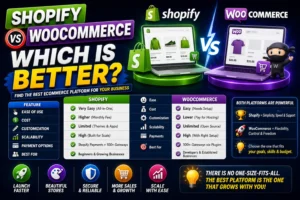
Shopify’s built-in feature set expanded dramatically over the past year. In 2026, every plan includes:
- Unlimited products
- Discount codes and gift cards
- Abandoned cart recovery
- Basic analytics and reports
- Shopify POS for in-person selling — the only ecommerce platform that includes a functional point-of-sale system at standard pricing
- Built-in tax calculation, including automatic international tax pricing by country
- Shopify Payments — no additional transaction fees when used
WooCommerce’s core plugin covers the essentials well but relies on extensions for most advanced functionality. Subscription products, advanced analytics, product bundles, multi-currency, memberships — these all require paid plugins. The extension library is enormous and genuinely covers almost any use case, but the cost and integration complexity add up.
Shopify wins on features out of the box. WooCommerce wins on the ceiling of what is possible when you are willing to build it.
AI Tools: Shopify’s Biggest 2026 Advantage
This is where Shopify has pulled significantly ahead, and it deserves specific attention.
Shopify Sidekick became generally available in January 2026 as part of the Winter ’26 Renaissance Edition. It now goes beyond answering questions. Sidekick can edit your theme through natural language instructions, set up Shopify Flow automations, analyse sales and customer behaviour data, and generate marketing creatives. It supports voice and chat interaction in 20 languages.
Shopify Magic — the broader AI toolkit — handles product description generation, email writing, image editing, and customer segmentation automatically.
WooCommerce has no native AI features built into the core plugin. AI functionality requires third-party plugins, which exist but are fragmented and require manual setup and management.
If AI-assisted store management is important to you in 2026, Shopify is the clear choice. This gap is real and growing.
SEO: Where WooCommerce Has a Structural Advantage
This is the one area where WooCommerce maintains a genuine edge.
WooCommerce has a structural SEO advantage due to WordPress’s mature blogging engine, flexible URL structures, and plugins like Yoast SEO and Rank Math that give you granular control over every technical SEO element. WordPress was built for content publishing first, and that foundation shows in how well it supports complex SEO strategies.
Shopify has improved significantly on SEO in recent years. It eliminated the duplicate /collections/ URL issue that caused problems for many stores. It handles sitemaps, canonical tags, and schema markup well out of the box. For the vast majority of e-commerce stores, Shopify’s SEO capabilities are fully sufficient.
Where WooCommerce pulls ahead is in content-heavy SEO strategies. Stores that want to rank through a deep blog, complex content architecture, and full technical SEO control will find that WooCommerce gives them more to work with. The combination of WordPress and Rank Math is simply the most powerful SEO toolkit available for any e-commerce store.
In 2026, both platforms achieve comparable SEO results when properly configured. But WooCommerce still offers more granular control over URL structures and technical SEO for stores that need it.
For most stores: SEO parity. For content-heavy, technically demanding SEO strategies, WooCommerce has the advantage.
Performance and Speed
Shopify’s performance floor is higher. Even a poorly optimised Shopify store rarely drops below three seconds of load time. Shopify delivers a 1.8-second average page load out of the box, backed by global CDN infrastructure.
WooCommerce performance varies enormously based on hosting quality and optimisation. A well-optimised WooCommerce store on quality-managed WordPress hosting matches or exceeds Shopify’s performance. Only 51% of WooCommerce stores achieve sub-second speeds after optimisation. A poorly optimised WooCommerce store on cheap hosting can hit 8 to 10 seconds — and by that point, you have lost half your visitors before they see a single product.
Shopify wins on consistent baseline performance. WooCommerce can match or beat Shopify when properly optimised — but requires that optimisation effort.
Security and Maintenance
Shopify handles all security, SSL certificates, PCI compliance, and platform updates automatically. You do not think about infrastructure because Shopify manages it.
WooCommerce stores are your responsibility. Plugin updates, WordPress core updates, hosting security, backups, malware scanning — all of this falls to you or a developer you hire. A WooCommerce store that falls behind on updates is genuinely vulnerable. This is a real ongoing cost of the platform’s flexibility.
For store owners who do not want to think about security, Shopify is the safer choice.
Data Ownership and Lock-In
This is a point that most comparison articles ignore, and it matters significantly as your business grows.
WooCommerce runs on your server with direct database access. You own your data completely. Migrating away from WooCommerce to any other platform is technically straightforward. You can export everything.
Shopify is a hosted SaaS platform. You cannot export all data in a fully portable format. Migrating away from Shopify is significantly harder than migrating from WooCommerce. The longer you run a complex Shopify store, the more dependent you become on Shopify’s ecosystem.
This is not a dealbreaker — it is a trade-off. The convenience Shopify provides is real. But going in with eyes open about platform dependency is important.
For full data ownership and platform independence: WooCommerce.
Scalability: Which Platform Handles Growth Better
Both platforms scale — but differently.
Shopify scales effortlessly on the infrastructure side. Adding more products, more traffic, and more variants does not require you to upgrade your hosting or think about server capacity. Shopify handles it. Shopify Plus at $2,500 per month unlocks enterprise features — advanced checkout customisation, dedicated account support, and higher API limits — for high-volume merchants.
WooCommerce scales well when managed properly, but scaling requires active management. As traffic and product volume grow, hosting infrastructure needs to grow with it. This is manageable, but it adds a layer of technical decision-making that Shopify abstracts away entirely.
For businesses that expect rapid growth and want infrastructure that scales automatically, Shopify is lower friction. For businesses that want to control their costs as they scale, WooCommerce offers better economics at high revenue.
Shopify vs WooCommerce clear difference
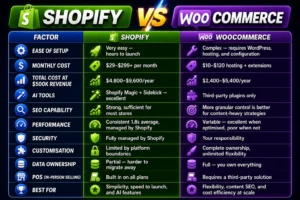
| Factor | Shopify | WooCommerce |
|---|---|---|
| Ease of Setup | Very easy — hours to launch | Complex — requires WordPress, hosting, and configuration |
| Monthly Cost | $29–$299+ per month | $10–$120 hosting + extensions |
| Total Cost at $500K Revenue | $4,800–$9,600/year | $2,400–$5,400/year |
| AI Tools | Shopify Magic + Sidekick — excellent | Third-party plugins only |
| SEO Capability | Strong, sufficient for most stores | More granular control is better for content-heavy strategies |
| Performance | Consistent 1.8s average, managed by Shopify | Variable — excellent when optimised, poor when not |
| Security | Fully managed by Shopify | Your responsibility |
| Customisation | Limited by platform boundaries | Complete ownership, unlimited flexibility |
| Data Ownership | Partial — harder to migrate away | Full — you own everything |
| POS (In-Person Selling) | Built in on all plans | Requires a third-party solution |
| Best For | Simplicity, speed to launch, and AI features | Flexibility, content SEO, and cost efficiency at scale |
Who Should Choose Shopify in 2026
Choose Shopify if:
- You are launching your first store and want to be live quickly without technical complexity
- You want AI-assisted store management, marketing, and content creation built in
- You sell in person as well as online and need an integrated POS
- You want Shopify to handle hosting, security, and updates so you can focus entirely on selling
- You are comfortable with the monthly subscription model and the platform’s boundaries
Who Should Choose WooCommerce in 2026
Choose WooCommerce if:
- You already have a WordPress website and want to add e-commerce to it
- You have technical resources — a developer or a strong technical background — to manage a self-hosted platform
- Content marketing and blog-driven SEO are a core part of your growth strategy
- You want complete ownership of your data and full flexibility to customise every aspect of your store
- You are building at scale and want to control costs as revenue grows
The Final Verdict
There is no platform that wins universally. The question is which platform wins for you.
If I am advising a first-time store owner who wants to sell products and not think about technology, I recommend Shopify without hesitation. The setup is fast, the AI tools are genuinely useful, and the peace of mind of a managed platform is worth the subscription cost.
If I am advising a business with technical resources, a content-first growth strategy, or a need for complete platform control, I recommend WooCommerce. The flexibility is real, the SEO ceiling is higher, and the economics improve significantly as revenue scales.
What I would tell anyone making this decision: do not choose based on which platform is more popular or which comparison article recommends it more enthusiastically. Choose based on your technical capability, your growth plans, your budget, and how much ongoing platform management you are willing to handle.
Both Shopify and WooCommerce are genuinely capable of powering a successful, growing ecommerce business in 2026. The difference is in the path you take to get there — and which path fits your reality.
Author – Navdeep Kr
I am a digital marketer who creates content about SEO, Meta Ads, Google Ads, Website Development, and e-commerce growth strategies. I create genuine, experience-based solutions for store owners, marketers, and entrepreneurs to improve business results. If you believe that your online business is not progressing as expected. Don’t hesitate to get in touch with me to access all your online solutions in one place.