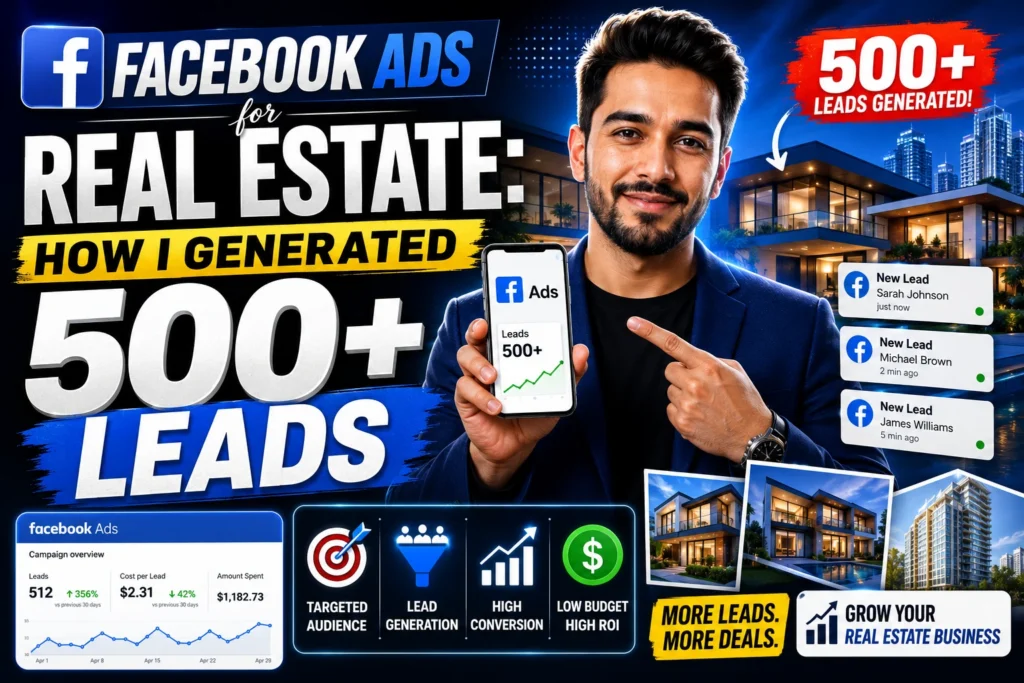
Facebook Ads for Real Estate: How I generated 500+ real estate leads using a specific Facebook Ads funnel and ad strategy. Here is the exact targeting, creative, and follow-up system I used — and the CPL numbers behind it.
Facebook Ads for Real Estate With the Lowest CPL
I want to start with a number that still surprises me when I think about it.
The first month I ran a properly structured Facebook Ads campaign for a real estate project, we generated 74 qualified leads at a cost-per-lead of ₹340. The previous agency had been running the same budget for three months and averaging ₹1,800 CPL. Same city, same project, same target buyers. Different strategy.
By the end of month four, we had crossed 500 leads. Not form fills from vaguely curious people — actual qualified prospects who answered a screening questionnaire, confirmed their budget range, and expressed genuine purchase intent. A significant portion of those converted into site visits. Several of those converted into actual sales.
This article is the exact strategy I used. Not a generalised overview — the actual targeting logic, ad structure, funnel sequence, creative approach, and follow-up system that produced those results. I am writing this the way I wish someone had written it for me before I spent months testing what did not work.
Why Facebook Ads Work for Real Estate but Most Campaigns Fail
The Platform Advantage Nobody Uses Correctly
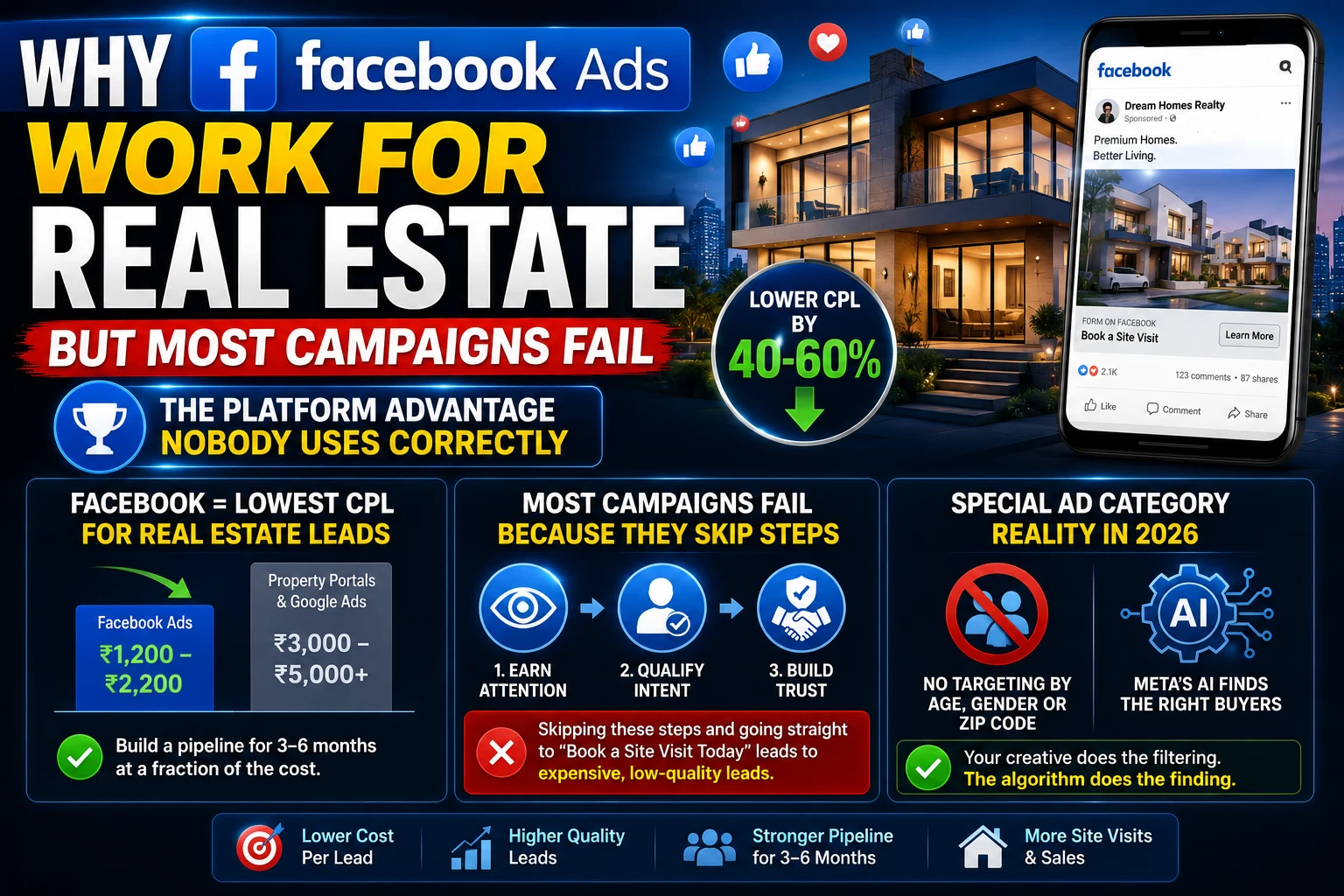
Facebook remains the most cost-efficient channel for real estate lead generation, outperforming property portal leads on a cost basis by significant margins. While search intent leads from Google or housing portals have higher immediate purchase intent, Facebook ads generate volume at the top of the funnel — allowing you to build a pipeline for three to six months out at a fraction of the cost.
The average real estate CPL on Facebook across 2025 and into 2026 averaged ₹1,200 to ₹2,200 across most Indian real estate markets when campaigns were run without proper structure. With the right strategy, that number drops by 40 to 60%.
The reason most real estate Facebook campaigns fail has nothing to do with the platform. It has to do with running awareness-level ads and expecting decision-stage conversions. People scroll Facebook casually. They are not searching for a property. You have to earn their attention, qualify their intent, and build enough trust that they willingly raise their hand — in that order.
Most campaigns skip the first two steps and go straight to “Book a Site Visit Today.” That is why they generate expensive, low-quality leads.
The Special Ad Category Reality in 2026
One thing you must know before setting up any real estate campaign on Facebook: housing ads fall under the Special Ad Category. This restricts certain demographic targeting options — you cannot target by age, gender, or specific ZIP codes the way other advertisers can.
What this means practically: success in 2026 real estate Facebook advertising relies less on manual audience selection and more on creative qualification — using the ad content itself to attract the right buyer while letting Meta’s machine learning handle distribution. Your creative does the filtering. The algorithm does the finding.
This is actually a better system than it sounds, once you understand how to use it.
The Three-Stage Funnel I Built
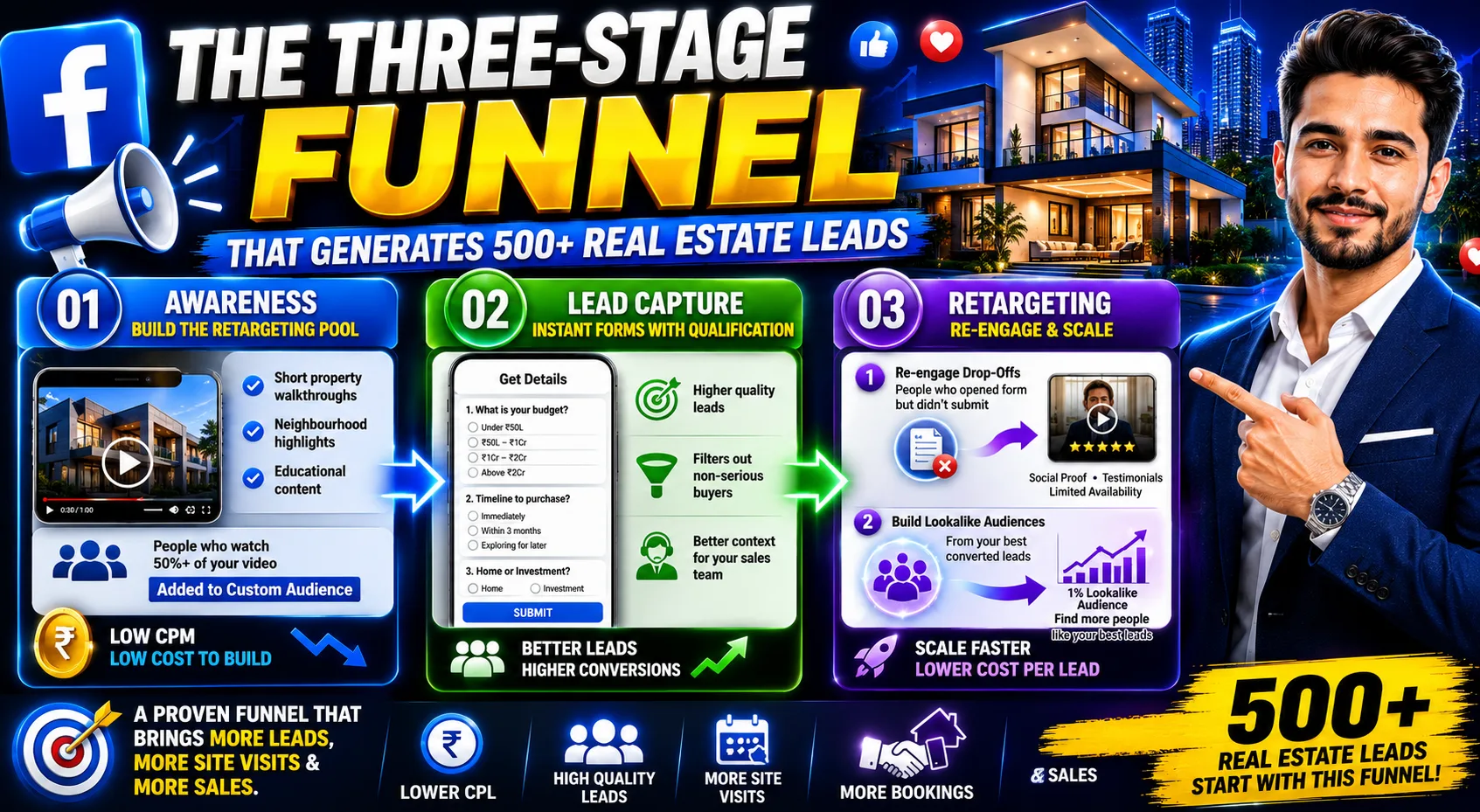
Before I describe any individual ad or targeting choice, I want to explain the overall structure. Everything else is built around this funnel — and every campaign I have run that has failed skipped one of these three stages.
Stage 1: Awareness — Build the Retargeting Pool
The goal of this stage is not leads. The goal is attention and engagement from people who match the profile of a real buyer.
I run video ads here — specifically, short walkthrough tours of the property, neighbourhood highlights, or honest educational content like “What You Should Know Before Buying a Flat in [City].” These are not sales ads. They are interesting ads. I want people to watch at least 50% of the video because that tells me they are genuinely interested — not just passively scrolling.
Every person who watches 50% or more of a video gets added to a custom audience automatically. This is your warm retargeting pool. It costs almost nothing to build. The CPM on video awareness ads is low. And the people inside that pool are significantly more likely to convert when you reach them in Stage 2.
Stage 2: Lead Capture — Facebook Instant Forms With Qualification
This is where the leads come from. Once someone is in the retargeting pool from Stage 1, I target them with a Lead Generation campaign using Facebook Instant Forms.
The form is not a basic “Name, Number, Email” form. A basic form generates cheap, low-quality leads because the friction is too low — anyone taps it without thinking. I use a higher-intent form structure that includes two or three qualifying questions:
- “What is your approximate budget for this property?” (Multiple choice: Under ₹50L / ₹50L–₹1Cr / ₹1Cr–₹2Cr / Above ₹2Cr)
- “What is your timeline for making a purchase decision?” (Immediately / Within 3 months / Exploring for later)
- “Are you looking for a home or an investment property?”
These questions do two things. First, they filter out casually curious people. Anyone unwilling to answer three simple questions is not a serious buyer. Second, they give your sales team context before they make the first call, which dramatically improves conversion rates from lead to site visit.
Stage 3: Retargeting — Re-engage Drop-Offs and Build Lookalikes
Stage 3 targets two groups: people who opened the Lead Form but did not submit, and existing converted leads who can be used to build a Lookalike Audience for prospecting.
People who opened the form and did not submit are high-intent individuals who got cold feet or got distracted. Reaching them again with a slightly different message — social proof, a testimonial video, a limited-availability angle — recovers a meaningful percentage of those leads at very low cost.
The Lookalike Audience built from actual converted leads is the scaling mechanism. Once I have 300 to 500 quality leads in the system, I upload them as a Custom Audience and build a 1% Lookalike from it. This tells Meta to find people who look statistically like my best leads — in behaviour, interests, and engagement patterns. That Lookalike then feeds Stage 1 as a prospecting audience.
The Exact Targeting Setup
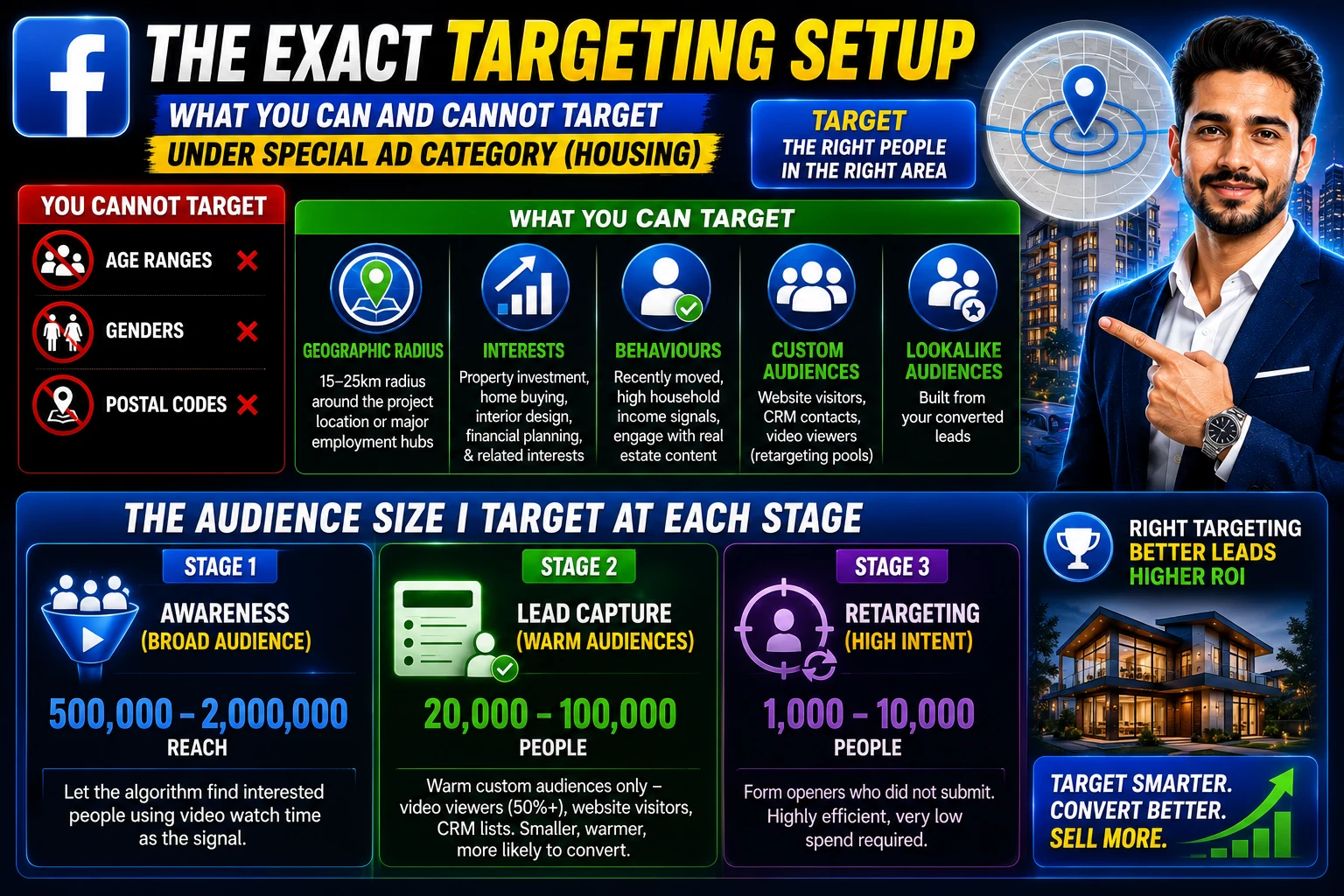
What You Can and Cannot Target Under Special Ad Category
Under the Special Ad Category (Housing), you cannot target specific age ranges, genders, or postal codes. What you can target:
- Geographic radius — I target a 15 to 25km radius around the project location, or around major employment hubs where target buyers typically work
- Interests — property investment, home buying, interior design, financial planning, and related interests that signal someone is in a buying mindset
- Behaviours — people who have recently moved, people with high household income signals, people who engage with real estate content
- Custom Audiences — website visitors, CRM contacts, video viewers
- Lookalike Audiences — built from your converted leads
For most residential real estate projects in Indian metros, I start with a broad geographic + interest audience in Stage 1, then narrow to custom and lookalike audiences in Stages 2 and 3.
The Audience Size I Target at Each Stage
- Stage 1 (Awareness): Broad. 500,000 to 2,000,000 reach. Let the algorithm find interested people using video watch time as the signal.
- Stage 2 (Lead Capture): Warm custom audiences only — video viewers (50%+), website visitors, CRM lists. Typically, 20,000 to 100,000 people. Smaller, warmer, more likely to convert.
- Stage 3 (Retargeting): Very small — form openers who did not submit. Often 1,000 to 10,000 people. Highly efficient, very low spend required.
The Creative That Actually Converts
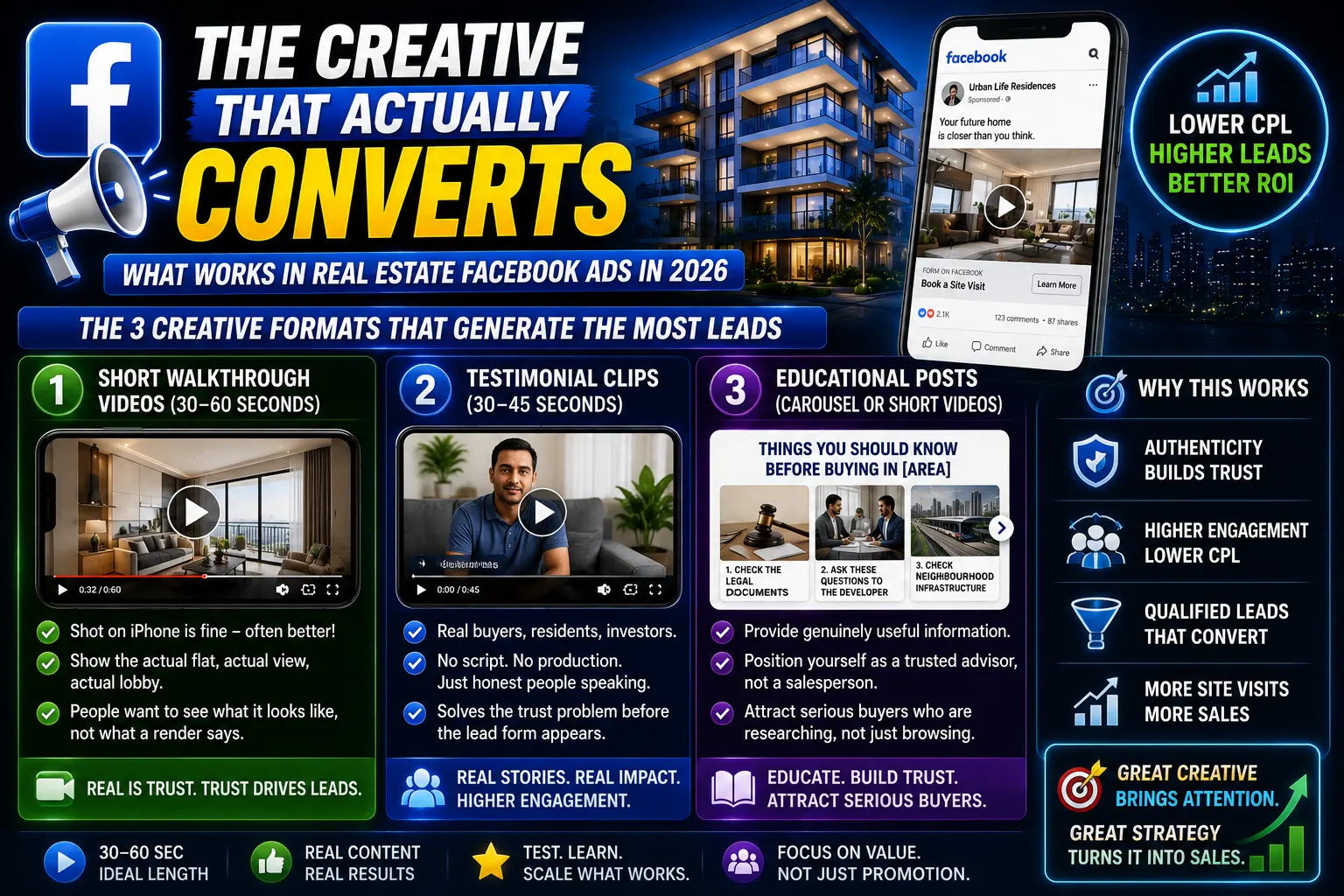
What Works in Real Estate Facebook Ads in 2026
The creative approach that consistently produces the lowest CPL for real estate is not polished architectural renders. It is authenticity.
The ads that have driven the most leads in my campaigns across 2025 and 2026 fall into three categories:
- Short walkthrough videos (30 to 60 seconds): Shot on an iPhone is fine — often better than a glossy production video because it feels real. Show the actual flat, the actual view, the actual lobby. People are buying a home. They want to see what it looks like, not what a render says it might look like.
- Testimonial clips (30 to 45 seconds): A real buyer — existing resident, early investor, site visit attendee — speaking for 30 seconds about their experience. No script. No production. Just an honest person speaking. These generate some of the highest engagement rates of any real estate creative format because they solve the trust problem before the lead form even appears.
- “Things you should know before buying in [area]” educational posts: A carousel or short video that gives genuinely useful information — what to check in the legal documents, what questions to ask the developer, what the neighbourhood infrastructure looks like. These position you as a trusted advisor rather than a salesperson, and they attract buyers who are seriously researching rather than casually browsing.
What to Write in the Ad Copy
The ad copy that converts in real estate follows a simple structure:
- Line 1: Specific, concrete hook. Not “Luxury 2BHK Available.” Instead: “2BHK in [Neighbourhood] | ₹67L All-Inclusive | Ready Possession.”
- Line 2: The qualifying statement. “Ideal for working professionals looking for a low-maintenance home near [business district].”
- Line 3: The proof point. “300+ families already call [Project Name] home.”
- CTA: “Get the Floor Plan + Price Breakdown” performs better than “Book a Site Visit” at the top of the funnel because it is lower friction. Save the site visit CTA for the retargeting stage when intent is already established.
The Follow-Up System That Converts Leads Into Site Visits
Generating leads is the beginning, not the end. The gap between CPL and cost-per-site-visit is almost entirely determined by what happens in the first 60 minutes after a lead submits their form.
The follow-up sequence I use:
- Minute 0–5: Automated WhatsApp message acknowledging the enquiry and sending the floor plan PDF or project brochure. This sets a professional tone and gives the prospect something tangible while they wait for a human call.
- Minute 5–15: First phone call attempt from the sales team. Speed to contact is the single most important variable in real estate lead conversion. Every hour that passes between form submission and first human contact reduces the probability of conversion significantly.
- Hour 2: Second contact attempt if the first call was unanswered — either a call or a personalised WhatsApp message referencing their budget range and timeline from the qualification form.
- Day 2 and Day 5: Follow-up sequences with specific, useful information — “You mentioned you were looking in the ₹50L–₹1Cr range. Here is a comparison of options in that range in [area]” — not generic “are you still interested” messages.
The follow-up sequence is where most real estate campaigns lose the leads they paid to acquire. A ₹300 lead that never gets called within an hour is a ₹300 loss. A ₹300 lead called within 5 minutes and handled by a trained salesperson is the beginning of a potential ₹30 lakh transaction.
The Numbers Behind 500+ Leads
I want to be specific because vague case studies are not useful.
The campaign I am referencing here ran for four months for a residential project in a major Indian metro.
Total ad spend: approximately ₹1,85,000. Total qualified leads generated: 512. Average CPL: ₹361.
The breakdown by stage:
- Stage 1 (Video Awareness): ₹45,000 spent. Built a retargeting pool of approximately 28,000 people who watched 50% or more of the video content.
- Stage 2 (Lead Capture from warm audiences): ₹1,10,000 spent. Generated 412 qualified leads with a three-question qualification form.
- Stage 3 (Retargeting drop-offs + Lookalike prospecting): ₹30,000 spend. Generated 100 additional leads at a blended CPL slightly higher than Stage 2 but converting at a better rate due to repeated exposure.
Of the 512 leads, 187 converted to phone conversations, 94 converted to site visits, and 11 converted to confirmed bookings during the campaign period. The value of those 11 bookings was approximately ₹7.5 crore. Ad spend was ₹1.85 lakh.
FAQs
What is the average CPL for real estate Facebook Ads in India in 2026?
Without a structured funnel, most campaigns average ₹1,200 to ₹2,200 CPL. With a proper three-stage funnel using warm audience retargeting and qualifying lead forms, the CPL drops to ₹300 to ₹600 for most residential projects.
Should I use Facebook Lead Ads or drive traffic to a landing page?
For volume and lower CPL, Facebook Instant Forms (native Lead Ads) win. They reduce friction because the user never leaves the platform. For higher-quality leads willing to do more work, a dedicated landing page with a longer form produces better intent signals. I use Instant Forms for Stage 2 and landing pages for high-value premium projects where quality matters more than volume.
How long does it take to see results from Facebook real estate ads?
Month one typically shows erratic performance while Meta’s algorithm learns your audience. Month two shows improved CPL as the machine learning identifies optimal segments and delivery times. By month three, you have reliable data to make decisions and a retargeting pool large enough to run Stage 3 effectively.
What budget do I need to start Facebook Ads for real estate?
I recommend a minimum of ₹50,000 per month to run a three-stage funnel properly. Below ₹30,000, you do not have enough budget across all three stages to generate sufficient data for Meta’s algorithm to optimise effectively. The sweet spot for most residential projects is ₹75,000 to ₹1,50,000 per month.
How do I qualify leads through Facebook Ads without reducing volume?
Use Facebook’s “Higher Intent” form type rather than the default “More Volume” form. Add two to three multiple-choice qualifying questions about budget, timeline, and purchase intent. This increases CPL slightly but dramatically improves the quality of leads your sales team receives — reducing wasted call time and improving conversion rates downstream.
What is the biggest mistake real estate advertisers make on Facebook?
Running conversion-stage ads to cold audiences. Asking a cold audience to book a site visit before they have ever seen the property is like proposing marriage on a first date. Build awareness first, warm the audience with video, then ask for the lead. The CPL difference between this approach and direct cold conversion ads is significant.
The Strategy Is the Asset
The real estate market is competitive. Every builder, every developer, every agent is spending money on digital advertising. The difference between the campaigns that generate leads at ₹350 CPL and the campaigns that generate the same leads at ₹1,800 CPL is not the budget. It is the structure.
Build the awareness pool first. Do not skip Stage 1 because you are impatient for leads. Those video viewers are your most valuable asset — a warm, pre-qualified audience that has already demonstrated interest before you spend a rupee on lead capture.
Qualify your leads through the form. The three-question qualification structure feels like friction, but it is actually a filter that makes everything downstream — sales calls, site visits, conversions — more efficient.
Follow up immediately. The CPL is only the beginning of the equation. What you do in the first fifteen minutes after a lead submits a form determines whether that lead becomes a site visit. What your sales team does in the next seven days determines whether that site visit becomes a booking.
The funnel I described in this article is replicable. The numbers I shared are real. The strategy works because it respects how buyers actually behave — they need to discover, trust, and then act. Build your campaign around that journey, and the leads will follow.
Author – Navdeep Kr –
I am a digital marketer who creates content about SEO, Meta Ads, Google Ads, Website Development, and e-commerce growth strategies. I create genuine, experience-based solutions for store owners, marketers, and entrepreneurs to improve business results. If you believe that your online business is not progressing as expected. Don’t hesitate to get in touch with me to access all your online solutions in one place.